Veronica Quattrocchio investigates how brands and social media turn feminist empowerment and online aesthetics into purchasable lifestyles.
Have you ever asked yourself how much of what you like is genuinely what you like? Where do your preferences come from? We are already aware of the power social media holds to influence our choices, but this influence extends beyond individual products sponsored by influencers or brands. While doomscrolling, how much of the content you watch belongs to the same aesthetic, gives off the same ‘vibes?’ Have you ever found yourself thinking, ‘This would suit me,’ and wanting to be that girl?
This happens because one of the main bases of marketing is to reshape products into experiences: identities such as the ‘clean girl’ and the effortlessly confident girl are sold as lifestyles that can be reached through certain products and routines that we are taught to desire. Furthermore, everything is seen through the potential empowerment these versions of ourselves could give us, including reframing beauty routines as acts of self-investment and self-realisation.
This is commodity feminism. The term was introduced by Robert Goldman, Deborah Heath and Sharon L. Smith in 1991 to describe the way advertisers take elements of feminist discourse and transform them into marketable signs that can be attached to brands. By doing this, feminist ideas are detached from political movements and collective struggles, and instead translated into individual qualities that consumers are invited to acquire through the right choices. And these qualities are indeed confidence, independence and self-realisation.
The issue is not that skincare, makeup or traditionally feminine products are inherently oppressive, but that the abundance of consumer choices do not translate to real transformations of women’s conditions. Being able to choose between countless lip glosses and empowering t-shirts – like Dior’s ‘We Should All Be Feminists’ – does not give women greater power over their safety or against the gender pay gap.
While commodity feminism describes this broader commercial mechanism, which can be harmful for the feminist discourse, we should give credit to brands which in the last decades have been incorporating feminist ideas. This positive revolution is called femvertising. A concept comprising – guess what? – feminism and advertising.
In an industry where women have often been portrayed only for the so-called male gaze, the website SheKnows.com decided in 2014 to raise public awareness of the traditional gender stereotypes tied to women in advertising and question them. Since then, this new term was adopted in day-to-day life to refer to advertising that uses female-centric talent, messaging, and visuals to uplift and inspire women and girls.
The personal care brand Dove has launched what is still today one of the best-known examples of femvertising.
In 2004, a photography exhibit titled ‘Beyond Compare: Women Photographers on Real Beauty’ showed the work of 67 female photographers, which led to the Real Beauty campaign, with the aim to widen the definition of beauty. It featured women of various ages and body types, as opposed to polished models. The series received significant media coverage, and successfully increased sales of Dove soap from $2 billion to $4 billion in three years. Following this, the campaign expanded with a series of television spots, culminating in the 2006 Little Girls global campaign and Daughters, which consisted of filmed interviews about how mothers and daughters related to modern perceptions of beauty and the beauty industry.
This campaign has the merit of having started a trend of companies incorporating body positive messaging and casting ‘real’ people in their advertisements. This encapsulates the main positive of femvertising: it provides younger generations with a more realistic, positive and inclusive representation of women. It can also draw attention to important issues, as demonstrated by Always’ #LikeAGirl commercial, in which, by asking adults and young girls to run and fight ‘like a girl,’ it is revealed how the expression becomes associated with weakness as girls grow older, exposing a gender stereotype that is learned rather than natural.

However, we should also consider the flip side of the coin. The above-mentioned Dove campaign itself started a powerful public debate. It has been criticised firstly for retaining a focus on physical beauty and encouraging people’s self-awareness of their own bodies. Moreover, it is argued that these ‘real’ women align enough with pre-existing ideals that they too would be accepted by most beauty standards, and no women with disabilities were portrayed, resulting in limited inclusivity.
This campaign is, of course, also a marketing campaign and an efficient one, as we saw before, it succeeded in resulting in higher profits for the company. The risk of femwashing is therefore always around the corner. It is impossible not to perceive the hypocrisy when you discover that Dove’s parent company, Unilever, owns other brands (such as Axe, SlimFast and Glow & Lovely) that are marketed using ideas contradicting those of the campaign.
In conclusion, perhaps the problem is not that brands have entered feminist conversations. Nevertheless, we should always remain critical of the intentions behind their messages and the products they sell while labelling them as’ empowering.’ The danger lies in social media’s tendency to allow the market to define what we need in order to feel good about ourselves, instead of focusing on the real battles that today’s feminism has to face. We may be free to choose between countless products and possible versions of ourselves. But the real question is whether we are equally free to change the conditions that taught us to desire them.
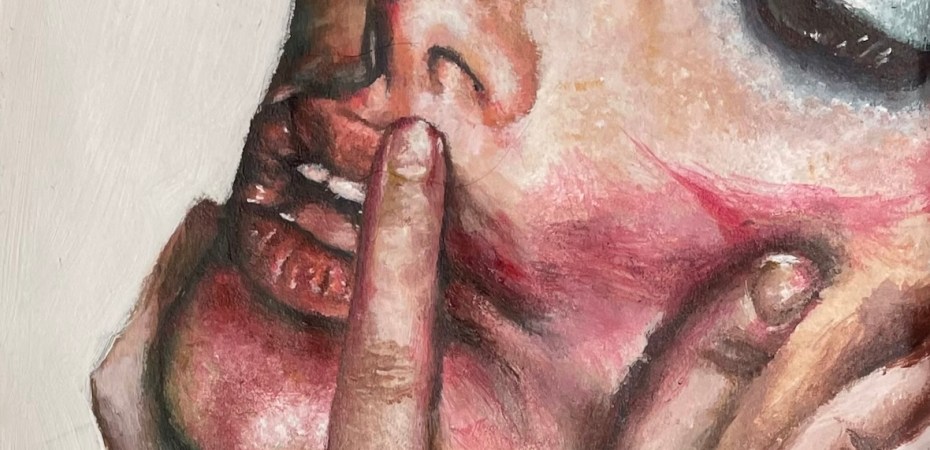
Artwork by Rebecca Minshull

