Amelia Cooper investigates the impacts of Tik-Tok’s ‘girlification’ micro-trends and how this interacts with Postfeminist structures.
I have recently been part of many discussions warning about the increasing presence of far-right narratives online, which rightly warrants concern. From the manosphere’s dangerous definition of masculinity to viral content of public debates that argue for misogynistic and traditionalist values, it is hard to avoid. Are we, however, mistakenly placing all concern on male-dominated narratives whilst failing to acknowledge the equally harmful postfeminist ideologies hiding in plain sight?
Postfeminism is the cultural assumption that feminism’s work is done and that female power now lies in individual choice. Rosalind Gill describes it as a sensibility encompassing a set of ideas that repackage traditional femininity as personal freedom, using feminism’s language of power to disguise the reproduction of patriarchal norms.
Being caught in a doomscroll is often mindless. First, a video of a young girl jokingly justifying her purchase to her dad; a collage of aesthetic pictures depicting a flawless woman in a spotless kitchen; a bubbly young woman excited to share her makeup tips. In this scenario, it may be hard to see a problem.
However, TikTok’s ‘girlification’ micro-trends not only reproduce postfeminist norms but make them structurally invisible. Patriarchal ideologies (that many only associate with the far-right) are repackaged as authentic peer expression, as part of a feminine community and self-care/improvement. “Girl math” is such a widespread trend that it has become a slogan, with the main hashtag displaying over 300,000 results. While ‘girl math’ may appear as a harmless joke about reframing economics to justify purchases, regardless of user intent, the result is women being displayed as financially incompetent and shopping obsessed. Whilst chick flicks have historically displayed females as reckless shopaholics, they are obviously external media productions. TikTok allows the same harmful female trope to appear as though it comes from within the demographic being stereotyped, leaving its patriarchal messaging invisible.
I can already hear certain people saying ‘it’s not that deep’, but treating these trends as too trivial to critique is exactly what leaves them circulating unchallenged. The postfeminist idea that such narratives can be reclaimed reflects the dangerous individualism of choice-feminism, where we seem to have forgotten the need for collective action.
Infantilising trends have become popular enough to earn their own mascot. The ‘I’m just a girl’ trend often displays videos of women finding the workplace too overwhelming and being generally physically weak. As part of this trend, a small hamster with baby-like googly eyes wearing a bow is used to embody females and femininity. Structural oppression has been translated into relatable identity. One particularly telling post depicts this hamster as part of an office meeting, and when asked, “What are your thoughts on that?” she is transported into bed and responds with “I’m literally just a girl”.
We see the depoliticisation of feminist issues, where being “just a girl” is used as an excuse to avoid work, implicitly returning women to the home, which is exactly the role the far-right would call a woman’s rightful and traditional place.
Reflecting on the invisibility behind such trends has led me to examine my own content consumption. Personally, ‘girl math’ and ‘I’m just a girl’ are seemingly obvious in their infantilisation of women. However, when looking at the self-commodification of women, ‘no-makeup makeup’ was a trend I never saw an issue with. This is not to say there is anything wrong with wearing minimal makeup; rather, I want to reveal the postfeminist sensibilities behind the language creators use to describe the trend.
‘No-makeup makeup’ is a trend composed of tutorials describing each step in creating a “skin-like finish” and “undetectable makeup”. These young women with seemingly flawless skin share how they achieved the look, to “make it glowy so it looks like real skin”, recommending products and techniques. It is characterised by the ironic promise that if women follow certain steps, use certain techniques and certain products, they will look natural.
The narrow patriarchal beauty standard is now a ‘fun’ trend shared amongst feminine communities on TikTok where natural skin is something that must be carefully curated. Postfeminist sensibility frames self-surveillance as fun and self-indulgent, which, according to Rosalind Gill, must never be disclosed as labour. The labour of creating the ‘perfect skin-like’ finish is not just undisclosed; it is actively disguised as its own absence.
Yet the trend containing the obvious parallels to the manosphere does not receive a fraction of the concern. While the sentence: “Feminine energy isn’t loud, let your softness be powerful” may sound like something a far-right account would post to convince women of their traditionalist position, instead it is a command posted under the ‘soft girl era’ trend.
‘Soft girl’ guides teach you how to achieve peak femininity which, according to soft girl guides, includes domestic chores, fitting a narrowly defined beauty standard and the notion that a loud, messy, and opinionated woman is not feminine. The trend is largely dominated by the idea that this retreat of femininity into the private and quieter sphere is, ironically, a form of female power.
These submissive patriarchal ideals (which are painfully similar to far-right philosophy) are framed as authentic self-improvement, completely removed from the patriarchal world they exist within. What we are left with is a resurgence of patriarchal values driven by women themselves and disguised through postfeminist ideologies.
Submission is dressed as self-determination, and it is dangerous to ignore how ‘girl math’, ‘I’m just a girl’, ‘soft girl’ guides and ‘no-makeup makeup’ continue to mirror the same particular standards that the far-right aims to enforce. Postfeminism would say such narratives are being reclaimed from within, with choice feminism following as a close supporter of this narrative; however, these similarities are not coincidental, and ‘girl’ trends are in desperate need of re-politicisation.
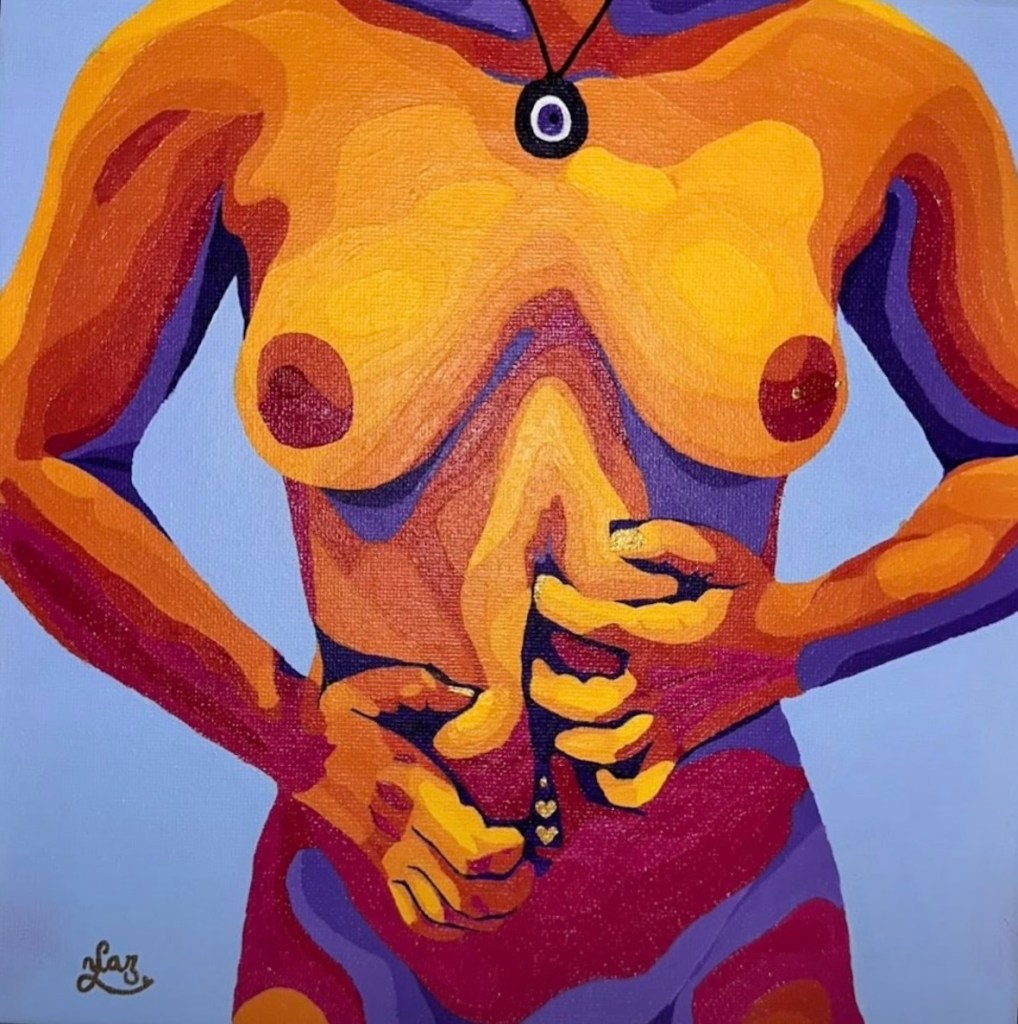
Artwork by Yasmin Burt

