Poppy Couzens and Millie Stephenson examine how the Victoria’s Secret Fashion Show’s rebranding as the ‘girlies Super Bowl’ disguises outdated ideals of femininity, and why the conversation should focus on the fashion rather than the women wearing it.
Nothing says Monday morning like a feed filled with lingerie.
As I unlocked my phone and got stuck into my habitual morning scroll, bleary-eyed and definitely in need of a coffee, there it was: Kylie Jenner in a $50 million bra. That certainly wasn’t all: the bra, it turned out, was the least of it.
The internet seemed entirely polarised by the Victoria’s Secret Fashion Show runway, the online debates had begun. commentary moved down the production line and straight to our phones. There is seemingly an increase in censure about who is on the runway, their celebrity or body, in place of what is being showcased.
Although it may seem harmless at first glance, the growing use of the term ‘the girlies’ Super Bowl’ as a synonym for the Victoria’s Secret fashion show is at the root of this hidden issue. An interest in fashion textiles is being replaced with fashioning text messages.
It’s important that, if you are going to worship the runway you must first familiarise yourself with how to be critical in an ethical manner. After all, nobody grades the Super Bowl by the players’ muscles…
On paper, the comparisons both make sense: two live and globally celebrated spectacles. Why can’t a show about women just be a show about women, all kinds of women, and why does it need this ‘AKA’ tag of men’s sport culture as its newfound reference point? Well, the comparison expresses the key issue with the failed progression of what society believes women care about. The recent surge in debate surrounding the comparison between women’s sexuality and men’s sports requires addressing and has been propagated by Sydney Sweeney’s advert for American betting company Novig. The advert echoes the imagery of Sports Illustrated magazines of the 80s using women’s bodies as sexual tools to promote sport.
Antiquated as it all is, Novig’s advert was pure marketing genius. They got exactly what they wanted: attention. Women are now being used to reverse parts of the social progress they’ve made with regression acting as a tool of popularity. The rhetoric employed by the media and audience in comparison to men’s sport reflects the sheer grandeur and scale of the show – however it’s the crux of the issue. The terminology not only highlights the regressive nature of the media but also acts as a plate, serving empty dishes that the audience will fill with criticism. The VS fashion show has developed into a phenomenon scaling as large or larger than the Super Bowl. Victoria’s Secret is, in 2026, the ‘Super Bowl of runway shows’. It’s still selling the same traditional fantasy but masked by the pretence of progression, although, the reason for their break from the show after 2019 was to ‘evolve the marketing’ as views hit lower than ever.
In 2018, the parent brand’s own chief marketing officer Ed Razeks told Vogue that trans and plus-size women ‘did not exemplify the fantasy that Victoria’s Secret were trying to sell’. Following backlash, the show was cancelled the next year. An attempt to push for inclusivity was introduced in 2024, when Valentina Sampaio and Alex Consani became the first openly trans models to walk the show, and plus-size models Ashley Graham and Paloma Elsesser made their VS debuts. Valentina Sampaio also became the first openly trans woman to appear in Sports Illustrated in 2020. This ‘inclusivity’ all still falls under the facade of modernisation as the commentary of the show does.The fashion industry was trying, however still plus-size models reportedly wore less revealing looks than their thinner peers and the trans models faced waves of online abuse. The casting of transgender and plus size models allows the show to seemingly challenge their historically narrow and unrealistic ideals, however representation (if we can even call it that) does not alone dismantle space for critique. They’re still overly trying to sell the same vision that was set out ten years ago, but things have changed.
Moreover the talk of those models with children, with fifteen mothers walking the runway, has been increasingly popularised on this year’s runway. Spotlight was shone on supermodel Barbara Palvin who was six weeks postpartum, and how incredible she looked, dubbed by reporter Melissa Minton as the ‘Mother Angel’. It sounds like progress, and in some ways the ‘Mother Angel’ tag appears empowering. Yet, we are nevertheless affirming the patriarchal idea that motherhood usually is a career in itself, and returning to the workplace, in this instance the Sony Studios LA runway, is almost unusual and taboo. Are we just reinforcing the same decade-long-tale that women can only be ‘Angels’ if they look a certain way? Modeling in motherhood isn’t new (Adriana Lima and Heidi Klum have walked after having babies in 2012 and 2009 respectively), but look at what’s being applauded, not the physical and emotional work but instead how she looked six weeks later.
It is so easy to fall into the trap of criticism. It’s no one’s fault, the backwards nature of the show hands critical thinking to the audience like an open platter. The show serves as a ‘Super Bowl’ spectacle of conventionally unachievable body types that women are bored of being told to desire. The challenge lies in avoiding subconscious critique of the models for the way they look, but instead the production of the show. The commentary surrounding the show has changed with the waves of social progression, but it’s still the same judgmental show that puts women against one another, masked by the facade of a new contemporary rebranding. After all, Victoria’s Secret shouldn’t need a Super Bowl to be culturally relevant and instead, maybe we just need to stop playing the game.
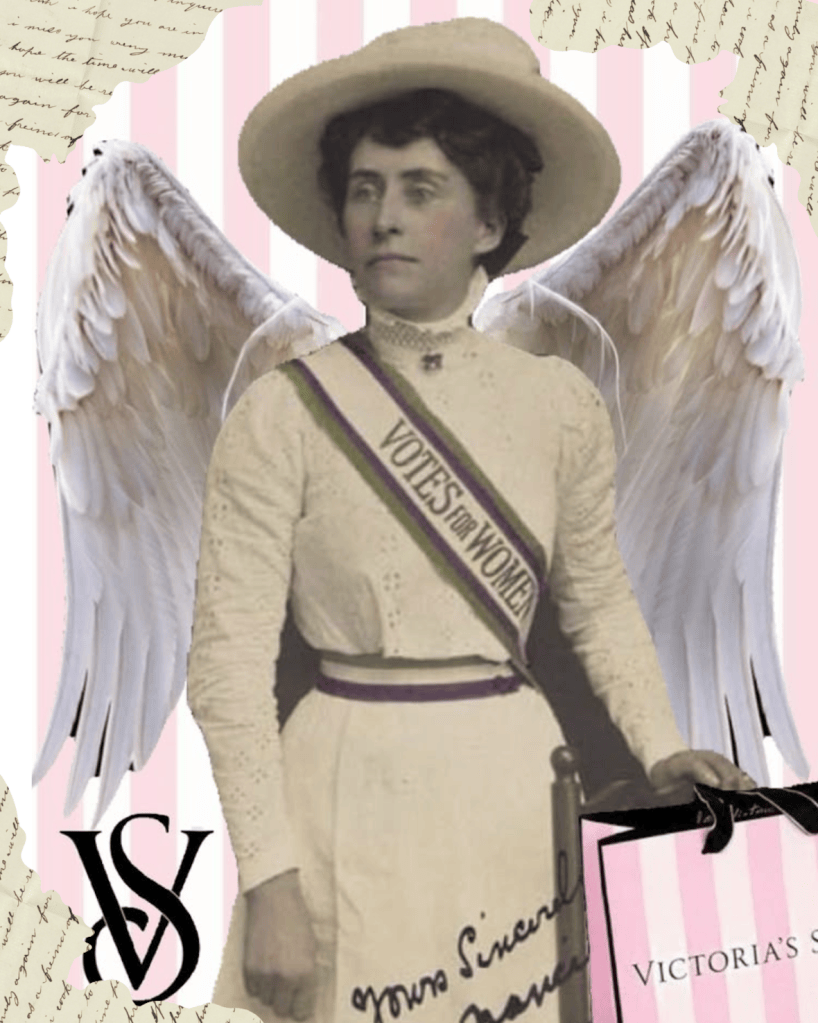
Artwork by Ella-Maria Jannetta

