Lisa Departon examines the reality of the homelessness crisis in Bristol, evaluating the role of gender within these structures.
As we probably have all noticed, Bristol is a city that hosts a tremendous amount of people suffering from homelessness. The number is estimated to be as high as 4,390 people, meaning 1 out of 113 residents. It is impossible to ignore. You can feel it in the busy streets of Stokes Croft, the lively corners of Gloucester Road, all the way to the quiet neighbourhood of Clifton. Bristol is committed to helping those in need: offering spaces in night shelters, council accommodation, supporting associations like St Mungo’s, food banks – yet the crisis remains painfully present. The economic climate in Bristol is currently at its worst: the city’s housing prices have recently surpassed London, making it officially the most expensive city for rent in the UK. This gentrification is only serving to worsen the class divide, making it harder than ever for those most economically vulnerable to find permanent housing, and pushing more and more families into sheltered accommodation.
Walking through the streets of Bristol, we may think that the crisis disproportionately affects men: it seems far more common that we see men sitting vulnerable on the pavement. Yet, the truth is far more complex: what is rarely seen or talked about is the city’s vast number of homeless women, and while their experience may be more hidden, it is not any less dangerous.
Indeed, women on the streets often tend to avoid public spaces associated with rough sleeping for safety reasons. They might want to hide their homelessness and seek shelter in squats, unofficial housing or even public transport, and as a result are frequently excluded from data, research, and public awareness.
The streets have always been and remain fundamentally male-dominated which makes the situation all the more difficult to navigate as a woman. Women are often associated with private spaces and indoor activities; shaped not only by ideas of safety but by cultural expectations that might link her to domestic responsibility. On the other hand, public spaces offer a sense of freedom for the men. This means that women’s presence on the street is judged more harshly, seen as ‘out of place’: Their behaviour is perceived differently, and their visibility is treated as more deviant than men’s.
Homelessness can be observed through a gendered lens. Not only do different genders enter this situation for varying reasons but they also experience it very differently. Studies have shown that women often enter homelessness through pathways tied to gendered violence – especially domestic abuse, which remains one of the most common causes. A woman on the streets is one of the most vulnerable; she has no shelter, no security, and is exposed to frequent violence and assault. All of this is with completely insufficient protection from society or the law. It is safe to say that crimes against homeless women often go unnoticed, neglected by authorities due to their marginalised status.
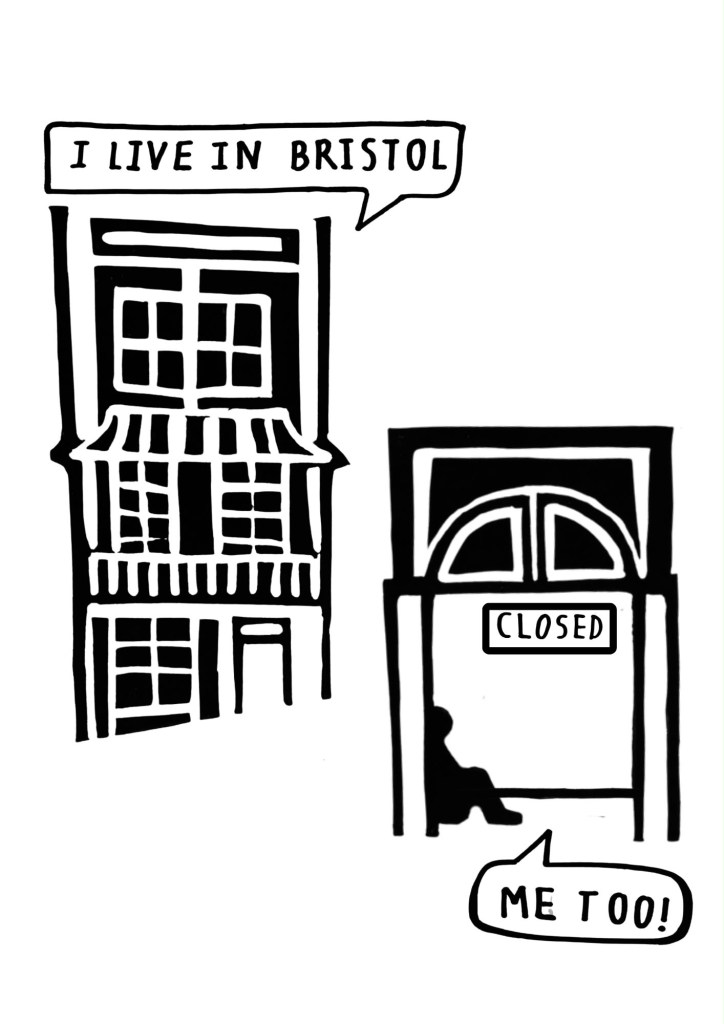
From the homeless women I have interacted with in Bristol, a lot of them have said that nowhere is safe. Where men may sometimes find community or protection within homeless networks, women remain exposed to exploitation, assault, and intimidation. Many describe being targeted by men, both within the homeless community and outside of it. Whilst being on a night out near Bristol-city center I started having a long conversation with a homeless woman seeking some type of shelter for the night. She explained to me what it was like being a woman on the streets and confided in me that the assault sometimes came from ‘drunk guys coming back from a night out’. For women who have fled abusive relationships, the streets often force them to relive that trauma daily.
I started volunteering at a homeless shelter in St Pauls and, interestingly, during the induction session we were told that ‘the women are most likely to be the most chaotic ones’. Now this is in no way because women are inherently more chaotic, but because their situation is shaped by trauma, violence, and severe mental strain. That made me realise how gendered homelessness truly is. This is even worse for homeless mothers who face additional stigma; often seen as ‘bad mums’ or ‘irresponsible’, looked down on and even treated with suspicion. This mirrors the broader pattern: women on the streets are seen as fundamentally different from men. The pressures exerted on them intensify mental health struggle and can make recovery significantly harder.
Bristol’s homelessness crisis reveals a pattern that affects women in profoundly different ways. Their pathways into homelessness, their experiences on the streets, and the obstacles they face in rebuilding their lives are shaped by violence, invisibility, and societal judgement.
Artwork by Mia Darlington

