Lily Crane questions heteronormative assumptions regarding the gender roles within queer relationships.
When I was asked the question, ‘So who is the man in the relationship?’ my first reaction was to let out a short, awkward laugh that soon turned into a sigh of resignation. My friend was inquiring into the details of my lesbian relationship; her tone was light-hearted, joking even, yet she looked at me with curiosity. I gave her a look of slight incredulity and replied, ‘Well, my favourite part is that there isn’t one.’ I found myself returning to this slightly frustrating conversation to reflect on the implications that many people believe there must be a man, even merely a female parody of a man, to make a relationship valid in our society. What does this say about gender identity within our culture and relationships?
This question first presents as an assumption about gender roles in relationships, but it really represents something deeper. In our society it is generally assumed that your sex equals your gender, which in turn reflects your sexuality. I am a cisgender woman and so expected to be with a man. Simone de Beauvoir argued, ‘One is not born, but rather becomes a woman.’ Maybe in a heteronormative context, one way of completing this ‘becoming’ is through finding a man. Perhaps the question is a nod towards this phenomenon: if you have not fulfilled your ‘womanness’ by being with a man, then maybe you must pivot and emulate one?
But let’s break the question down. What is it that a man is expected to bring to a relationship that makes its nonexistence destructive? Judith Butler views gender as constructed through repeated acts that, when performed incorrectly, result in punishment. Now you could see the question as a form of this: punishment as judgement. Clearly you are doing something wrong as women to be asked which of you is a man, but Butler’s logic could also apply to men in dating. For example, men can be judged for deviating from expectations to pay the dinner bill or wear trousers, not a skirt; these deviances may even result in rejection. So perhaps, my friend was not questioning the lack of a physical man in my relationship but rather the attributes she expects ‘him’ to bring. If we are both women, then who pays for dinner? In lacking the masculine, dominant presence, we are dangerously unfixed and subversive in our identities as women.
And yet, similar questions are thrown around towards straight couples: ‘Who wears the pants?’ Another question searching more for a masculine role, opposed to a literal man; the ‘pants’ referring to a sense of dominance and control. Relationships, regardless of gender and sexuality, always involve and require a balance; whether that be taking on a more caring, nurturing role when your partner is sick or merely being brave when they are anxious, there must always be a balance. In a heteronormative society, that balance is assumed to come from or require the male-to-female counterpart within relationships, and so maybe my friend’s question stems from confusion about how that balance functions within a lesbian relationship. That confusion thus forces the normative template onto a relationship that it doesn’t fit. It is rather confusing because society has been known to disapprove of masculine women. Perhaps because they don’t try to conform to what most men find desirable, or because their mere existence presents a challenge to the cisheteronormative idea of female identity. Yet if a masculine woman is with another woman, they are seemingly pushed even further into that definition of man. Words such as ‘tomboy’ suggest a kind of ‘knock-off’ man instead of an identity in its own right.
I suppose the question of who is the man really translates to ‘Where is the man?’ Yet in asking either question you are confronted with the simple reality that there isn’t one and doesn’t need to be one. This isn’t to say anything negative about men in relationships; it’s simply that gender identity in our culture seems to be based largely upon sex and sexuality, when these things do not normatively align, it can produce questions such as this. But this instance can also provide the opportunity to adopt a different perspective; perhaps being a woman dating another woman makes me ‘manly,’ or perhaps it makes me feel like even more of a woman. When I have dated men, I experience a sense of relaxation in that I feel more clearly what is expected of me; even if he didn’t place these things on me, the simple fact that he and I were together was enough for me to place them on myself.
Now, with my girlfriend, I feel a different kind of relaxation in that she and I are experiencing the world on similar planes; our bodies, brains, and experiences of norms have developed in parallel to one another. This, in my experience, allows me to feel subconsciously more relaxed in my gender identity. Which I believe could provide a window into a wider discussion around gender identity within relationships. In examining a wide range of lived experiences, one can appreciate the complexity and intricacy of our existence and hopefully create a future where individual identity is celebrated, not predetermined.
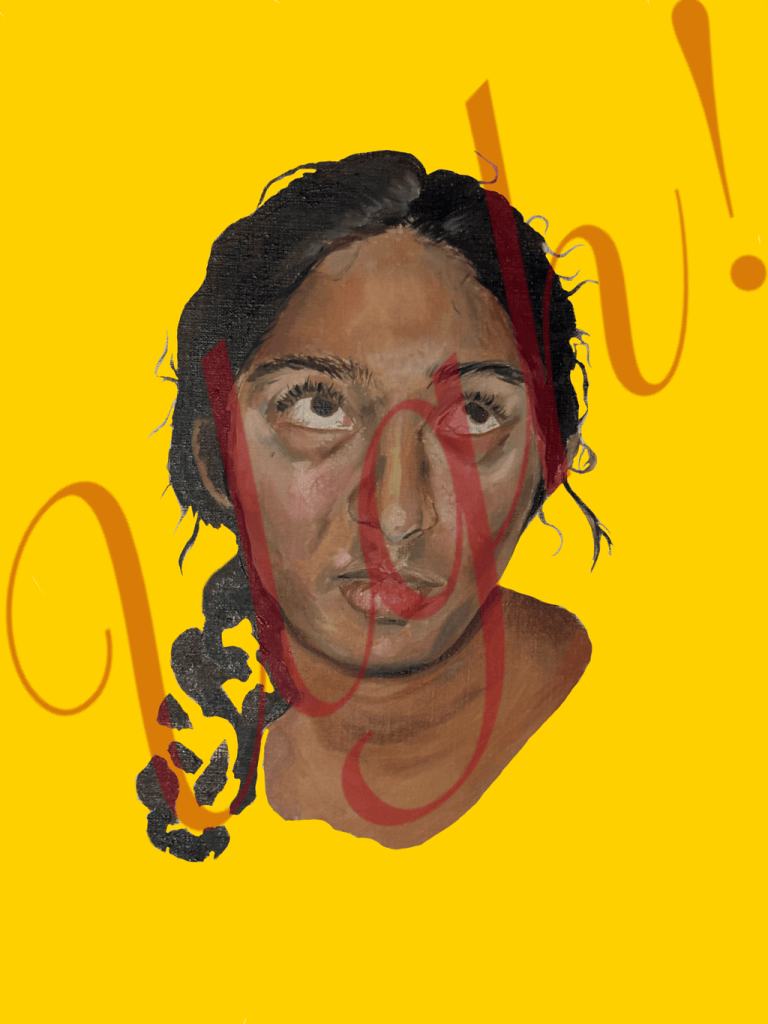
Artwork by Gia K. Sandhu

