
Sukhi Singh investigates the gender biases surrounding nudity and nightlife, analysing the implications of this in media and university culture.
It’s difficult to picture OMG as an environment rife with gender contentions. Every week the music plays. Boys line up on stage. They strip. Everyone laughs, films and cheers. They are completely exposed, yet their performance isn’t subjected to judgement; it holds comedic value. Have you ever wondered why it’s exclusively male students who get to go on stage and take the piss? Imagine a group of teenage girls doing the exact same thing. Suddenly it feels different. Why?
Male nudity is often perceived and presented through a comedic lens. We see male nudity in TV, film and culture existing without necessarily being sexual. By contrast, female nudity and bodies have been consistently displayed through a more sexual lens in mainstream culture. Unfortunately, society has constructed the feminine form as inherently sexual, whilst presenting the masculine form as neutral. A vehicle for laughter and fun, without any necessarily sexual connotations.
If female nudity is so normalised, why would a female student taking off her clothes at OMG be controversial? You would assume that the consistent visibility given to the female body would make nudity more widely accepted; however, visibility doesn’t equate to freedom. The visibility afforded to women is often demeaning rather than glorifying. An analysis by the Genna Davis Institute on Gender and Media found that women movie leads were four times more likely to be shown naked than their male counterparts. Yet ironically, such displays of female nudity have actually made women more subject to sexual judgment.
So why can’t women choose how their bodies are interpreted? Part of the answer lies in the commodification of female bodies; we have learnt to read the female body as primarily sexual before viewing it as anything else. Male bodies, however, have not been advertised for the male gaze, nor have they historically been marketed to others, allowing male nudity to be viewed as ‘safe’ compared with ‘threatening’ female nudity.
This objectification is evident in Sydney Sweeney’s recent advert. Considering female athletes have fought for greater recognition and respect, this oversexualised image in connection with sports sends a detrimental message about what women in sports should look like, framing women’s sport as an act of male voyeurism rather than an appreciation of talent. The advert is a pressing example of the continued commodification of women’s bodies for advertising.
Women are so often expected to be seen in a particular way; criticised for not revealing enough but also revealing too much, making them feel like they are never enough. You can be sexual, but not too sexual. Loud but not too loud. Confident but not too confident. It can feel so hard and so contradictory to be everything all at once. The same applies to female bodies; women are denied the freedom to decide what their nudity means for themselves.
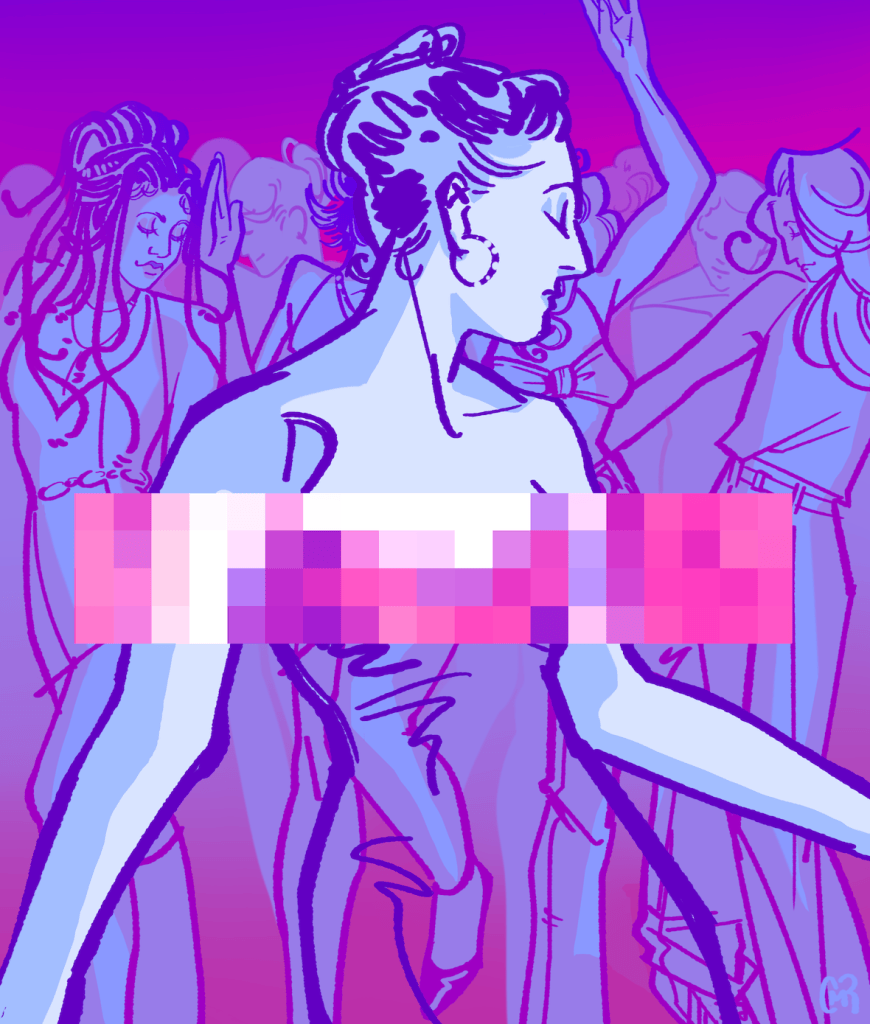
It seems that the female body is most socially acceptable when its meaning has already been decided for us; however, when women celebrate freedom over their own sexuality and bodies, that’s when they’re looked down upon. The second a woman takes her clothes off, everyone has comments to make concerning what it says about her, yet men never seem to face the same judgment.
Such a difference becomes particularly stark in a setting like OMG. If a female student were to strip at OMG, they would likely face far more damaging consequences in terms of shame, harassment, or issues with future employment – consequences male students are unlikely to suffer. Whilst the male students are having fun, laughing and cracking jokes with their friends, female students would be left worrying about their bodies becoming a character statement. Male nudity can be transformed into comedy; their bodies are a part of the joke rather than the subject of it, and they control the punchline. They can dance badly, mess around, and embarrass themselves without having to be desirable. A girl would face comments. Photographs. Gossip. Labels such as ‘slut.’
Why is it that female nudity carries a social price, yet male nudity doesn’t?
We have made the female body a public commodity, governed by social expectations. We are told that female sexuality has become far more liberated and we have increasing control over our bodies, but do we? Although women have more freedom to display their bodies, they lack the freedom to decide the implications of such visibility. We have grown up in a society where we are taught to look at women’s bodies whilst also teaching women they will be judged for displaying them.
I’ve watched the strip show and have never understood it to have sexual implications; most of the time, everyone thinks, ‘this is so stupid.’ Perhaps that’s what’s interesting about it. This isn’t an article to persuade women to strip at OMG, but rather a view on why women should be able to make such a decision themselves, without having to worry about the social implications.
Next week, when you’re at OMG cheering the boys on and having fun, watch how easily they become a source of comedy rather than judgment. Don’t think about why they are taking their clothes off; instead, ask why we find it so easy to laugh when, if it were a female student, it wouldn’t be received in the same way. A patriarchal society has made the female body highly visible, yet we still treat it as a statement about who a woman is.
Artwork by Chiara Robinson

