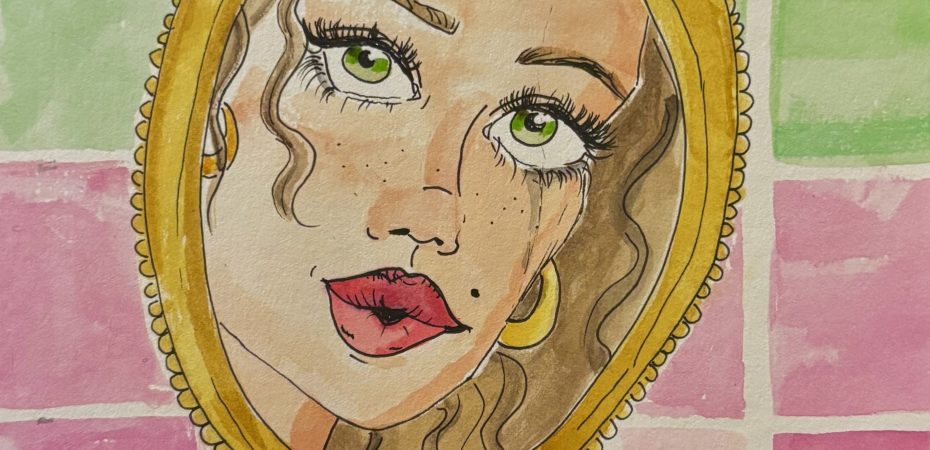
Chrissy Flannery explores modern-day selfie culture, personal identity, and social media illusions.
I’m sure some of you will have seen, and, like me, devoured with admiration similar to as one might a cult-leader, Jemima Kirke’s Instagram story Q and As: her deadpan, omniscient answers which resonate with young women, and her candid outlook for which she has gone viral.
Some of you may have also seen the infamous screenshot of a user asking her, ‘what advice would you give to unconfident young women?’ – to which Kirke responded: ‘I think you guys might be thinking about yourselves too much.’
Kirke is right: we have simply become too self-aware.
Nature gave us the gift of not being able to perceive ourselves. Before mirrors, the only image of oneself we could hope to find was the fleeting, rippling reflection in a pool of water; and even that was obscured. What a beautiful time it must have been…
Mirrors became commonplace around the 13th century and then portraiture came into fashion, starting with the most affluent families before trickling down to the middle class. Cameras came at the beginning of the 19th century, steadily growing in popularity until having one’s picture taken was no longer a defined event, and cameras were introduced to the mass market. Nowadays, the all-powerful smartphone has put a camera in the pocket of nearly everybody, giving us instant, unadulterated access to our own reflections.
The truth is, it was never meant to be this way. When it comes to obsession with one’s likeness, the words of Portuguese poet Fernando Pessoa feel particularly apt: ‘Man shouldn’t be able to see his own face – there’s nothing more sinister. Nature gave him the gift of not being able to see it, of not being able to stare into his own eyes.’ (I wonder what Pessoa would make of the ‘selfie’.)
We have become obsessed with self-branding, intent on creating a perfectly curated online image. The nature of the algorithm is such that it pushes only the most beautiful faces to the top of our feed, creating a completely distorted image of reality and consequently amplifying our insecurities. This saturation has naturally flattened out diversity, creating a totally homogenous standard which rejects uniqueness and which we must adhere to in order to be considered ‘beautiful’. Jia Tolentino coined the term “Instagram face” in 2019 to describe this standard; the “cyborgian” look we now consistently see on social media, characterised by fox-like eyes, full lips, poreless skin, a tiny nose. After all, social media is not an invention compatible with human nature. It fosters an environment which breeds and rewards vanity. We were never meant to see this many flawless faces and, most importantly, we were never meant to see this much of ourselves.
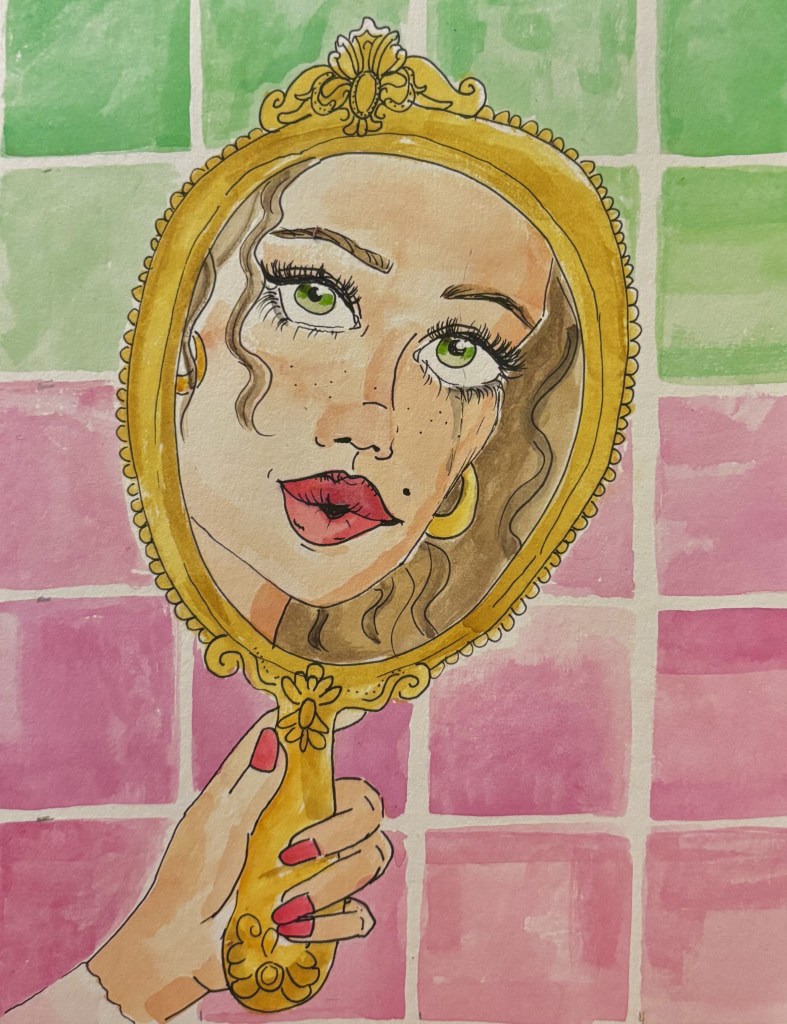
Facial dysmorphia is a concept unique to recent generations: a natural by-product of the unbridled access we now have to our own face. When I was 15, I was completely pre-occupied with my appearance; specifically, its shortcomings. I hated every one of my features. It was also at this time that I first downloaded TikTok and was welcomed to its skilfully curated algorithm, and unique ability to showcase endless videos of the most gorgeous women you have ever seen. It is also, conveniently, distinctly capable of recognising and catering to the obsessive viewing activity of a 15-year-old girl.
The endless stream of flawless looking faces amplified each one of my insecurities. I had a jar in my room specifically labelled ‘nose-job money’, and would take excessive pictures of my side profile, examining my nose and fantasising about the way I would reshape it with surgery. I remember also having a distinct feeling that had I been alive in the medieval times, I would have been ostracised as the village freak, as my face was so ugly it was actually beyond belief (God knows I loved the covid mask era).
Smartphones, front-facing cameras and social media are a curse. As nature would have it, our appearances would be none of our business; they would be free from the unforgiving scrutiny of our own perception. The only way to overcome this is to try, as much as we can, to become blissfully unaware of how we look, as nature intended. And realise that literally no one else notices our flaws to the degree that we do.
Whilst braces and acne treatment helped my self esteem, it was my inner self-image that had to change. Talking to friends made me realise that many of them also had insecurities which were totally invisible to me. I have had many conversations with my best friends in which we share our insecurities and are both mutually bewildered at how the other could possibly think that of themselves. I simply have to remind myself that whatever imperfections appear glaringly obvious to me, they are simply not perceptible to others.
Now, although I perhaps secretly do still wish for a nose-job, I have become a lot more accepting of my bumpy, pointed, definitely not ‘ski-sloped’ nose. We simply were not designed to observe ourselves as much as we do.
Artwork by Chrissy Flannery

