Niamh Healey examines the social and economic consequences of our devotion to Halloween.
Black cats, pumpkins, and costumes – Halloween is right around the corner, and for many, it’s all we’re thinking about. Pinterest boards are filling up, and everyone is asking, ‘What are you dressing up as for Halloween?’ Yet behind the face-paint and parties lurks a more sinister reality.
In recent years Halloween has boomed, to the extent that costume planning at times starts months in advance. Everyone wants the most niche, creative costume.
Halloween content dominates the algorithms, with ‘playing dress up’ at the very heart of it. Influencers like Sophie Silva have created entire brands from this, frequently racking up millions of views worldwide for each new costume idea. Video series such as ‘31 Days of Halloween’ feature a brand new and increasingly elaborate costume everyday in the lead up to Halloween. Whilst such videos are incredibly entertaining – and to all of us interested in fashion, creatively inspiring – they are not as innocent as they seem.
Such content pushes the idea that to enjoy Halloween and be socially accepted we must have extensive costumes, complete with ornate accessories and full faces of makeup. A simple black dress and gloves paired with your sister’s old witch’s hat is no longer enough. Nobody wants to be labelled boring, or worse, basic.
The idea that Halloween is a night of transformation is a popular one. Vulnerable young women online are sold the idea that they can transform into somebody different, somebody more attractive, somebody more desirable. But at what expense? Bank accounts drain as capitalism wins. Insecurities are preyed upon. The environment suffers. Who is really benefitting from such consumption? It is rarely us.
Following the wildfires which raged worldwide this summer, I think we all are beginning to realise just how serious climate change is. Many people have begun to recycle more and drive less in an attempt to help the planet. So why are we not more conscious about our Halloween celebrations? When Halloween ends, our costumes and decor are shoved to the side, thrown out, or lie untouched. Amazon corsets pile up landfills, Shein’s polyester costumes are stubborn in their refusal to biodegrade, and Halloween’s environmental impact lasts long past October 31st.
Influencers like Sophie Silva not only exacerbate this mass desire for multiple intricate costumes: they actively promote it, directly targeting young women and fuelling overconsumption. In comment sections, Silva links her costumes’ sources, frequently citing Amazon, the company singlehandedly responsible for almost 81 million metric tons of carbon dioxide being released in 2025. Likewise, the online fast fashion giant Shein is another retailer looming over Halloween, and one excessively promoted online. Yet the brand’s dark reality is almost entirely ignored, despite it now producing almost as much pollution as the entire country of Lebanon.
These Halloween videos, including advertisements, are heavily skewed towards females over males. In late 2025, it was found that 61.5% of TikTok’s adult audience for advertising in the United Kingdom was female. It is women, and in particular young women, who are dragged into online Halloween hysteria. Just as they are implored to buy every shade of the new Rhode Hailey Bieber blush, they are targeted to buy as many ‘niche’ Halloween costumes and accessories as possible, in the pursuit of social validation. Halloween overconsumption is almost exclusively concentrated in female buyers: out of every 10 Shein transactions, 9 are attributed to females. Women are both the victims and the perpetrators. Directly targeted by large corporations and social media, we are conditioned to consume as much as physically possible over the spooky season, directly contributing to the climate’s deteriorating state.
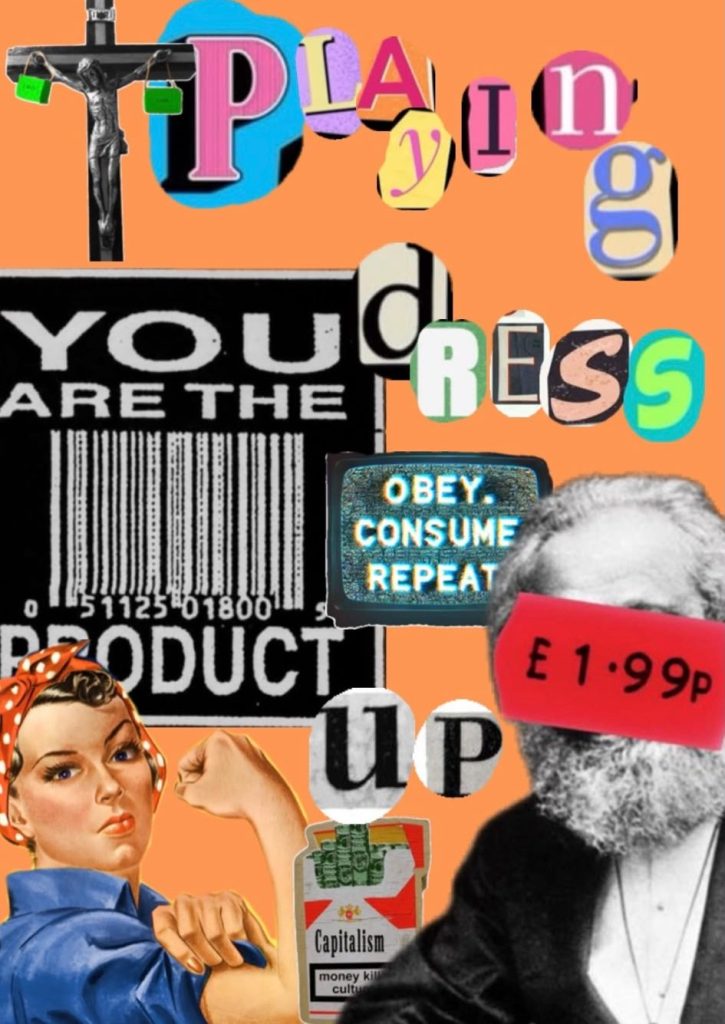
Thus, we become desperate consumers, constantly searching for more. Costumes can no longer be reused or borrowed from others, because who wants to be an outfit repeater? Social media ruthlessly champions this logic of consumption, just as it pushes a new insecurity every month, promoting the idea that Halloween will be the best night(s) of your life.
Amazon baskets fill up. Shein orders are placed. Halloween overconsumption begins.
But why is this significant? Online content implores its majority female audience to perpetuate trends, trapping the young women who idolise figures like Silva in an endless cycle of always wanting – and buying – more. It was estimated that every year, 2000 tonnes of plastic waste are generated by Halloween alone, with social media surely being a huge driver behind this. Halloween is no longer an innocent celebration; it has morphed into an unsustainable nightmare.
Ultimately, Halloween is an amazing night. So go out, dress up and have fun. But be conscious of your impact.
In reality, no one really cares what you’re wearing: whether it’s a reused costume or a designer one, people just want to enjoy the night. Share your old costumes with friends and reuse your own, raid the charity shops or turn to retailers such as Etsy before scouring Amazon.
Because a costume hand-curated through countless charity shop quests and Vinted searches will always be more impressive and creative than a 100% polyester Shein outfit. And likely more economical and eco-friendly too.
Artwork by Cherry Belcher

