Scarlet Richards examines why listening to rap can be a moral dilemma for feminists and what it reveals about how we think about culture and politics.
“Is it okay to listen to rap music as a feminist?”
Is a question I’ve kept tucked in the back of my mind, asked in hushed tones between friends or typed into a search bar with a hint of shame. Embedded within it, there’s an assumption: that our cultural taste must always align perfectly with our politics, and pleasure should map directly onto principle. I first felt this tension not in a lecture theatre or on an intersectionality thread, but in my brother’s car – where rap wasn’t a choice I made consciously, but an inheritance I absorbed. It didn’t enter as theory; it entered as a soundtrack.
Outkast’s expansive grooves and Kendrick’s introspective storytelling were my norm before they became items on any political checklist I felt I had to adhere to. Listening was instinctive and habitual, something felt rather than analysed.
These songs aren’t abstract objects to be judged in isolation; they are attachments, textures, embedded in memory and familiarity. Growing into my feminism made me more aware of the traditional expectations of femininity, and taught me to interrogate power and the gender imbalance enforced by patriarchal structures. In that way, this old comfort – a genre positioned as incompatible with feminist politics – started to feel like an unsettled contradiction. Yet, my attachment, rooted in emotion rather than conscious resistance, quietly disrupted those same expectations. The music that once felt instinctive now required justification and my enjoyment needed permission.
Rap is a predominantly Black cultural form shaped by structural violence, capitalism, misogyny, resistance, and creativity. Writers like Tricia Rose have long situated hip hop as a response to marginalisation rather than a simple reflection of it. In The Hip Hop Wars (2008), Rose is explicit that misogyny in rap is real and harmful, but she warned against treating it as a cultural anomaly. Instead, she situated it within an industry that rewards hypermasculinity, particularly when performed by Black men for mass consumption. To engage with rap is to engage with contradiction itself.
Yet, feminist discussions of rap often feel dominated by the need to explain or defend listening practice, particularly in online spaces where political identity is performed and scrutinised. Why does rap, in particular, become a moral test case for enjoyment?
Perhaps the problem isn’t solely misogyny in rap music, although that undeniably exists, but the assumption that personal preference must be politically coherent. A choice feminist framework often encourages the idea that as long as a choice is freely made, it is inherently feminist. This notion may be comforting for some due to the lack of judgment it creates. But this flattens history and culture, reducing complex engagements with art into questions of individual morality. Instead of asking “Is it okay?”, maybe the more revealing question is: why do we feel the need to ask for permission at all?
Kendrick Lamar is frequently positioned as the acceptable rapper within feminist conversation. His work is introspective and self-critical, invested in examining masculinity and accountability for his own personal struggles as in the lyrics of N95, where he urges himself to take off his emotional and material “masks” to confront his “ugliness” and allow healing from past wounds. Songs like u and Mother I Sober confront shame and vulnerability without seeking absolution (“I’m sensitive, I feel everything, I feel everybody”). For feminist listeners, there is comfort in this openness; Kendrick’s music appears to do its own ethical labour. The critique is already there. But that comfort deserves scrutiny. Why do we gravitate toward art that already articulates our critiques for us? What does it mean that accountability becomes a prerequisite for enjoyment?
Dave offers a similar sense of alignment. His work is emotionally open, politically conscious, and reflective, articulating the pressures of masculine ideals and racial hierarchies that continue to exist in contemporary Britain. Tracks like Black have been widely celebrated for their honesty and, as noted in The Guardian’s coverage of Psychodrama, for their absence of misogyny, Listening to Dave often feels affirming, like proof that vulnerability can live within rap and empathy can coexist with masculinity. Yet, feeling moved by an artist is not the same as justice. Emotional openness doesn’t dismantle power, even when it resonates deeply.
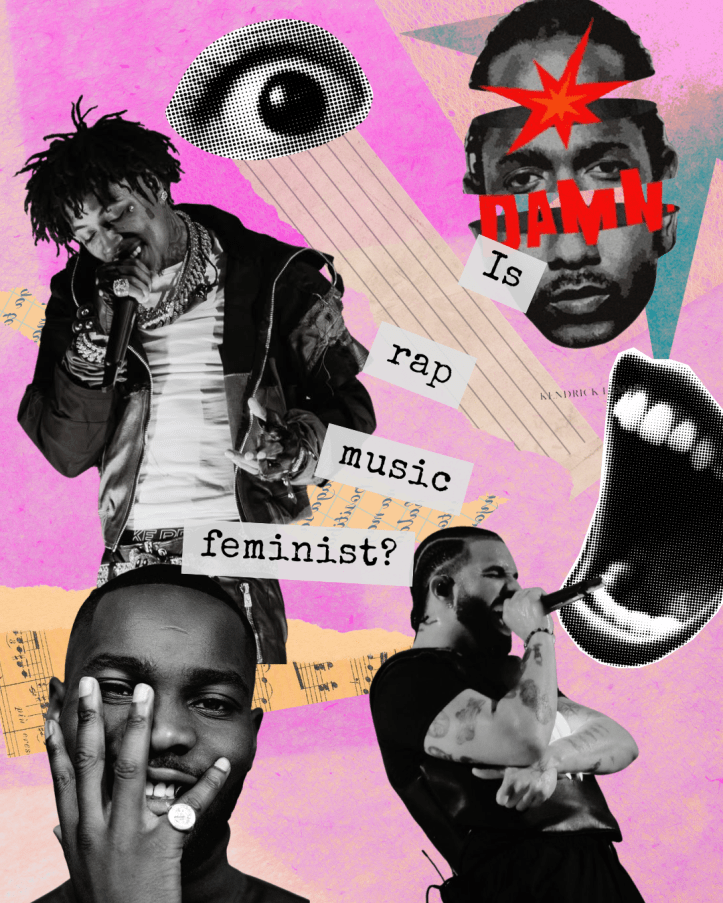
It’s with 21 Savage that the question becomes harder to sit with. His music doesn’t offer the same reassurance or visible self-reflection. Rolling Stone claimed that his 2022 album with Drake, Her Loss, leans on misogynistic tropes, dehumanising women as sexual objects to be conquered. Many feminists enjoy this music and yet that enjoyment is rarely spoken aloud. This silence feels potent. Perhaps in an era of intense media scrutiny, admitting such a pleasure feels risky. Why are some pleasures harder to admit than others? Why does feminist discourse make space for critique more easily than for enjoyment?
Admitting pleasure often feels riskier than admitting discomfort. Feminism, especially when performed online, can turn contradiction into failure, a tension explored by writers like Jia Tolentino, who writes about the demand for visible moral correctness within contemporary feminism. But cultural consumption has never been neat. Rap can be misogynistic and resistant, exploitative and expressive, often all at once. To demand purity is to misunderstand both art and politics.
So when I ask, again and again, “Is it okay?” Perhaps the more honest question is, “Why do I feel the need to ask?” I’m no longer convinced the answer matters. What matters more is the space to be honest about contradiction without turning feminism into a gatekeeper of taste. Feminism isn’t about resolving every tension we encounter. Maybe living with that tension is where feminist practice actually begins.
 That's What She Said Magazine