Carly Synnøve reviews Music Theatre Bristol’s Little Shop of Horrors
Please note, this is an unbiased review, but we were given a compensated press ticket to watch it.
Contains some spoilers for Little Shop of Horrors.
Student society Musical Theatre Bristol delivers camp cult classic Little Shop of Horrors with pizazz as their second main show of the year, on in the Loco Klub slot March 10-13 2026, with a tremendously talented cast of 17 and a clearly dedicated production team of 22.
Upon entering the Loco Klub, I was greeted by a loud, bright band number. The atmosphere was buzzing, and as I settled into my seat I chatted with a guy who was there to support his child in the cast. All the crowd seemed excited and joyful to be there for the (sold out!) 4-show run.
The chorus were all fabulous; while initially dressed in grey clothes, they brought energy, vivacity, and jubilance. Wonderful harmonies from these 12 women elevated the whole play.
The acting choices for Bristol Uni theatre staple Ollie Binnie’s sadistic Orin Scrivello DDS were particularly interesting in a feminist light. Binnie was able to fill the shoes of this larger than life character with zeal and passion. Using bold, expressive body acting in a very camp way, Binnie makes this villain less ‘cool’ or ‘aspirational’, and more comic. This reduced the scare factor of the dentist, dehumanising him as more of a clown than someone to be taken seriously. Binnie’s rendition of ‘Dentist’ with the lab-coat-reveal-from-leather-jacket at the start of the number was splendid, flamboyant, and full of character – a testament to his versatility as an actor.
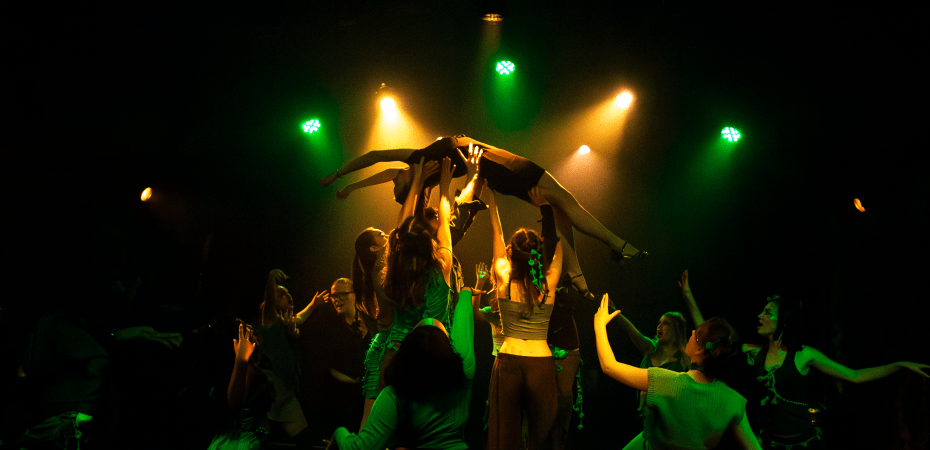
Binnie’s interaction with Seymour – the wonderful Coby Granek – during ‘Now (It’s Just the Gas)’ was an immaculate blend of fear, desperation, and hope. Granek used well thought-through gestures to convey appropriate likeability and nervousness. With Binnie’s (SPOILER!!) shuddering last breaths denoting the end of the gas-mask-clad dentist’s life, he in later scenes joined the carnivorous plant’s ensemble. This was a super interesting choice from the production team – not to have the standard puppet as Audrey II, instead displaying the insanely talented Sophia Christofi’s (in an effective red striped dark suit) eventual tyranny – from being surrounded by three green-wearing plant dancers to the whole cast progressively becoming plant as world domination occurs and Twoeys take over everything. Seymour gradually becomes outnumbered throughout the whole play as the only non-plant character, and he eventually joins them. All of the character deaths were choreographed very well (by Charlotte Musselle, assisted by Sophia Ward and Amber Rowlatt) – viscerally arranged, violent, but maintaining an element of fun: limp forms were lifted to be consumed by ever-growing plant. Christofi – alongside the ensemble – made Audrey II seem more sinister, and realistic, with poise and calculation delivered extremely successfully.
Mushnik (Seren Clayton) being cast as (in director Joe Balls’s words) ‘a butch lesbian business woman’ adds more of a queer lens to the play. She shone in ‘Mushnik and Son’, embodying the character with confidence and boldness.
Sophie Lee as Audrey is splendid – she has a beautiful clear voice, which she used to great effect in the ballad ‘Somewhere That’s Green’, where she wishes for a life in the suburbs, away from awful men. She fills the lyrics with a delicate delightful yearning, and smooth vocals. During ‘Suddenly Seymour’, she decides she can be safe with Seymour and try to live a quieter life. Staging is super effective here, highlighting power dynamics – Lee stands on a central podium, with Granek on his knees below at the start of the song, showing how (unlike Orin), Seymour actually cares about Audrey. As the song progresses, and Audrey becomes more comfortable, he joins her on the podium – showing a shift into a more equal power dynamic. I loved her leopard print heels as well, wonderful costuming!
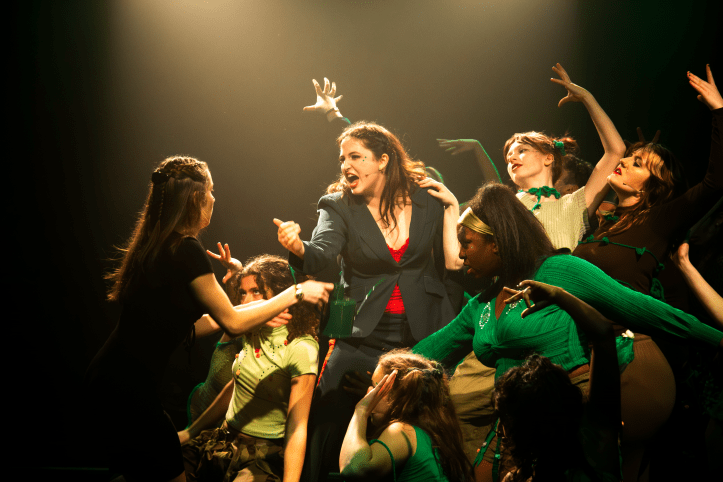
Whilst not to diminish the talent of everyone involved, I felt like the casting choices erased some of the cultural-historical themes of the show – the official casting information document suggests Crystal, Ronnette, and Chiffon should be played by actors of colour, and there seemed to be a lack of this in the company. Although these roles were absorbed into the wider chorus, the notion remains. After reaching out to MTB to comment, I was informed that this was considered as part of the process and those that were cast were ‘representative of the audition cohort’, and that they ‘attempt to put on shows in which any person regardless of their background or identification can play any role’ as well as the society being ‘student led’ without any ‘professional guidance’. An open conversation always remains to be had surrounding diversity in theatre, and MTB are no strangers to this, being conscious of such issues.
Themes of poverty (Skid Row) forcing destruction (the reliance initially on Audrey II as a source of profit, and then the plant being used to stabilise Audrey and Seymour’s relationship) seem super relevant to modern society, and the wrongs of capitalism. The rendition of ‘The Meek Shall Inherit’ was perhaps my favourite part of the show – with the three business people inhabiting very distinct characters, with money used effectively as a prop. Bernstein had a wonderful Jersey accent; the classy scarfed/sunglassed Mrs Luce flinging dollars with bombasticity; and Skip Snip being extremely camp, with a dynamically gestural and fun click dance personification.
Lighting was used effectively – in ‘Da-doo’, during the line ‘Total eclipse of the sun!’, a warm central beam highlights the plant entering the stage. Red and green lights used throughout symbolised brutality and hope. With a sort of minimalist set on difficult traverse staging, the lighting helped the pacing of the piece, creating an intimate feel. Flashlights used sporadically by the ensemble near the end assisted the wonderful mix of eerie but camp throughout. The band was wonderful in bringing the performance to life too, bringing a vibrant sound to the Loco Klub for the duration of my visit, although sometimes the lack of chorus member’s microphones made their lines difficult to discern.
The whole cast shone in the closing number ‘Don’t Feed The Plants’, a high-energy end to a wonderful bit of thoughtful student theatre. Everyone involved clearly fed a lot of blood, soul, and joy into the production and delivered.
Bop-sh’bop!
Featured Image: Isabel Rose Hay That's What She Said Magazine