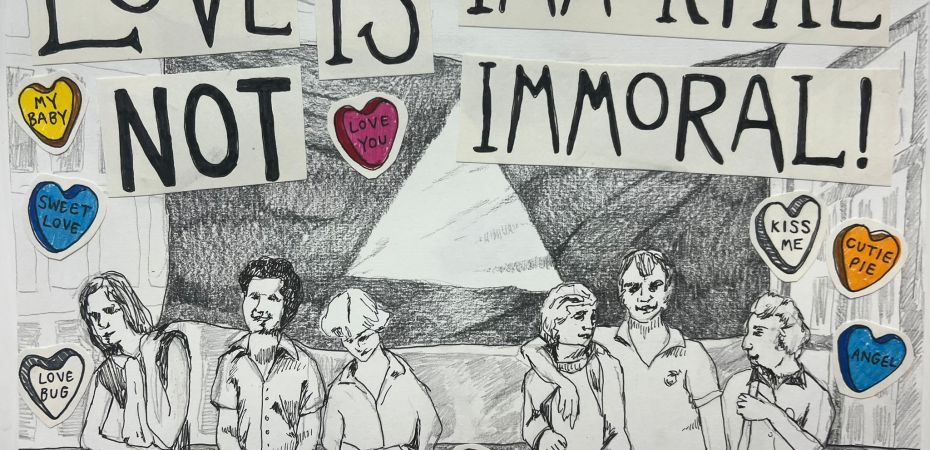
Madelaine Mitchell explores queer experiences of Valentine’s Day amidst a heteronormative society.
Valentine’s Day is often overshadowed by an idealised image of love between couples. A box of mass-produced chocolates. An exchange of bears adorned with hearts; an obligatory bad steak dinner for two. At the centre of this idealisation is the prioritisation of the romantic couple. A celebration of a monogamous relationship where love is mainly shared between partners. This fails to recognise the uniqueness of queer love and relationships.
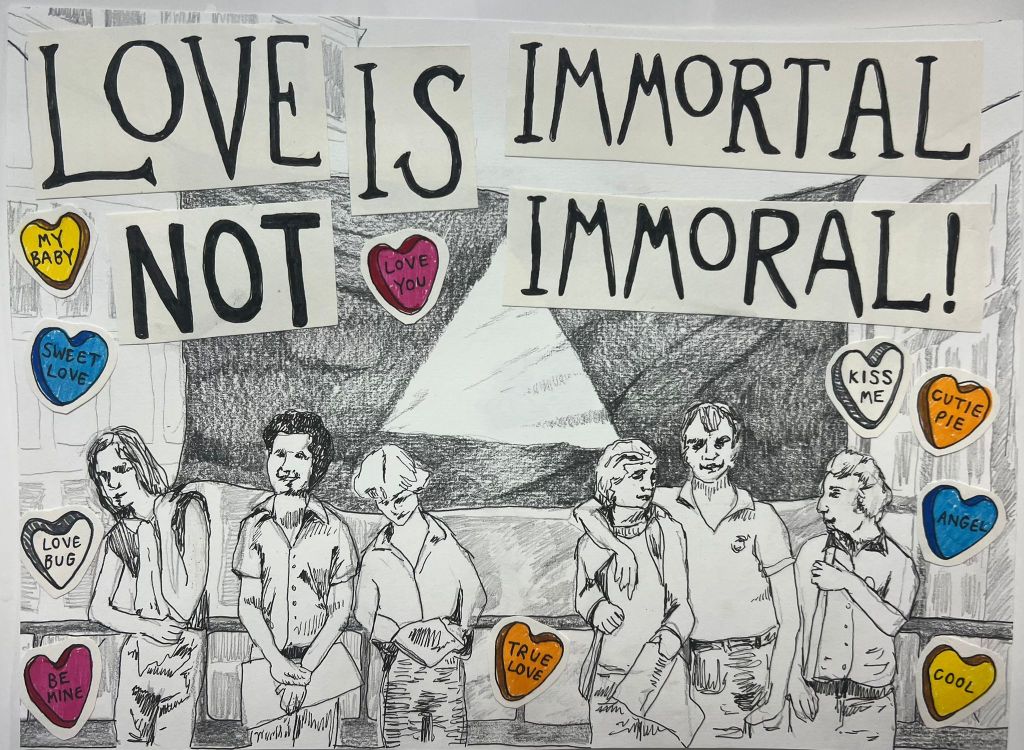
For many in the queer community, love is not a private transaction but rather is an outward expression. Queer love is a form of protest, granting us with a unique power to stand together and unite. This is very clear in Pride parades. When writing this article, I kept thinking about my experiences of Pride. Surrounded by friends who feel like family, drinking many M&S tin cocktails and running round London with Pride flags in hand waving them in unsuspecting tourists’ faces.
Pride shows the community that our strength is in the shared love we have and that we are forever stronger together than apart. These outward expressions of queer love and joy are exactly why as a community, we have thrived. Queer rights weren’t won quietly or secretly. Rather the community thrives on the collective and that shared love that we have. The communal love within the queer community is exactly why I feel like Valentine’s Day is a celebration which doesn’t always match queer experiences of love. It tries to take the vast and shared love of the community and squeeze it into something more small.
And at the heart of Valentine’s Day is a celebration of rebellion, the same way which has defined the progression of Queer rights. Valentine’s Day celebrates the story of the Roman priest who defied Emperor Claudius’ ban on marriage. Instead of adhering to law and regulations, Valentine performed secret marriage ceremonies for couples whose partnership was deemed unfit by the state. In this sense, Valentine was a rebel as well, and his story emulates many experiences of Queer individuals. A rebellion against dictated laws and heteronormative ideals, united by love.
bell hooks wrote, “‘to love well is the task in all meaningful relationships, not just romantic bonds”. hook’s writing feels encompassing of the queer experience when it comes to love, especially the platonic love throughout the community. Reflected in our concept of “chosen family”, in my experience queer individuals are able to establish deeply committed friendships where active love is central. By prioritising the wellbeing of the community rather than just the couple, queer love dismantles the idea that affection is a private act. Instead, it becomes a communal practice that thrives in shared spaces and loyalty to friends. This is supported by studies such as Homophily, Close Friendship, and Life satisfaction among Gay, Lesbian, Heterosexual, and Bisexual Men and Women, which found that friendship mutuality was more beneficial for life satisfaction among LGBQ individuals than heterosexual individuals. https://pmc.ncbi.nlm.nih.gov/articles/PMC8521548/#S2
The higher life satisfaction in queer friendships sources from the deconstructing of traditional gender roles. While heteronormative romance and friendships frequently rely on the rigid tradition of “provider” and “nurturer”, queer love thrives on a blank canvas. Because our relationships aren’t built on patriarchal blueprints, we are able to pursue bonds based on needs rather than societal expectations. This fluidity is what intersectional feminist writer Audre Lorde identified as the “erotic”, not just a sexual physical sensation but as a “resource within each of us” which comes to fruition when we live and love with intention.
Lorde argues that the “erotic” is a source of power that makes us more demanding of our lives and our connections. In the queer community, the “erotic” as a source of power and joy is prevalent. Many queer friendships demonstrate strength through being as deeply committed as romantic ones. Within my queer relationship and friendships, gender roles have been deconstructed, rejecting patriarchal ideals of how relationships should look. By moving past these boundaries, our connections have the potential to be more honest and display a greater level of intimacy.
Ultimately, what makes queer love so special is resilience. Our love is special because it is an active choice. A decision to commit to our friends, to prioritise the collective and to take up space together. In the end, many queer people may feel that Valentine’s Day doesn’t quite fit our expressions of love, but we should remember that we have already built a world that is much bigger.
 That's What She Said Magazine