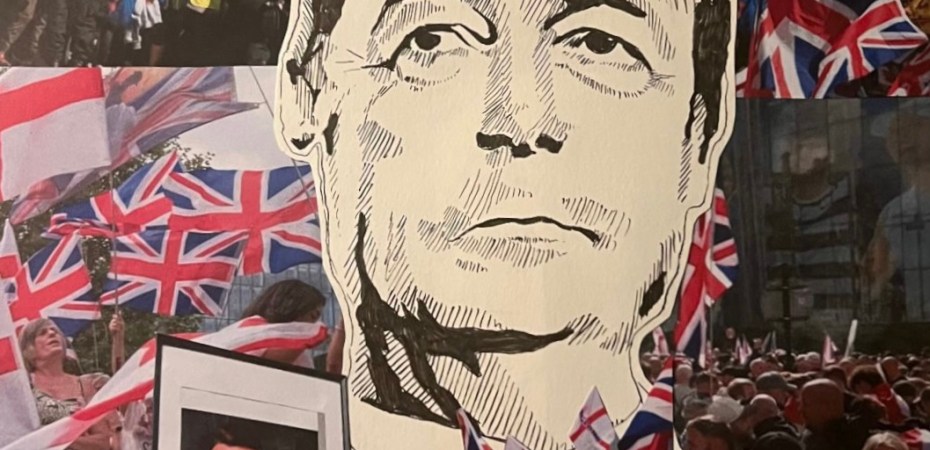
Esme Pearson on the rise of Reform UK and how the Union Jack has become a symbol of exclusion.
The history of the flag
Raising a flag ought to be a positive act, a time for national celebration, togetherness, and pride, but in truth our flag’s weaponisation is not unfamiliar. Political and ruling parties have routinely attached rhetoric to our flag in hope of unifying the nation in a common direction.
The most pertinent use of this propaganda comes from our past as a colonial power as both the St George’s Cross and Union Jack were symbolic of the domination and righteousness of The Crown’s sovereignty across the globe. Colonial heraldry was employed widely in colonised lands in an effort to replace and redirect cultural identities towards The British Empire. It was a highly effective policy: a physical manifestation of the power and authority of the colonial regime for over 400 years. For many, the legacy of Britain’s colonial past is still embedded into our perception of the flag, as a reminder of the oppression and violence curated by our nation.
During the 20th century the idea of empire was in clear decline and a more progressive approach emerged. Interventions in far flung territories – such as the 1980s war in the Falklands were largely viewed as a jingoistic distraction to domestic politics – and the mood of the nation took a dramatic shift with the election of Tony Blair. The Union Jack took on this new mood and came to embody what was known as ‘Cool Britannia’- a celebration of the international identity of the UK as a global leader in arts, music, and fashion. The most enduring image from this period is Spice Girls’ Geri Halliwell’s famous Union Jack dress, communicating the creativity behind British artistry.The notion breathed new life and excitement of opportunity in Britain, and helped Blair re-energise the nation to be newer, younger, and influential while still powerful.
Social Stagnation and Political Discontent: The foundation for increasing far-right nationalism.
Today, the flag is undergoing another shift, reemerging as the symbol of a far-right agenda, specifically the desire for tighter immigration policies. Whilst this association isn’t ‘new’, the growing confidence in its use is. On the 13th September 2025, 150,000 people, flags in hand, took to London for Tommy Robinson’s (real name Stephen Yaxley-Lennon) ‘Unite The Kingdom’ march. The flag was at the centre of one of Britain’s largest political marches of recent history, calling for a demand for freedom of speech, tighter immigration laws and the protection of British culture and people. Elon Musk, who attended the rally via video call, suggested a conspiracy theory that Starmer’s immigration policies were to import voters in a nation that otherwise wouldn’t vote him in power and used this to call for a dissolution of Parliament. The event saw a surge in racist agenda and a violent clash with police as it was confronted by a Stand Up to Racism counter protest.
This rise in this right wing, Anglomania ideology has been facilitated by the rise of Reform UK and serious political disillusionment across the nation. How has today’s Britain enabled this rhetoric?
In recent decades, statistics have shown that white lower income boys have the lowest access rates to higher education in today’s Britain. This is a complaint that many at Robinson’s right-wing march voiced– a young boy interviewed by the Guardian said: “I feel our country is being inundated with the ideology which is trying to suppress and suppress us.”
What Reform UK offers to these communities is a ’clear answer’ that the problem is caused by ‘mass’ immigration overwhelming the employment demand, and reducing access opportunities for the white working class of Britain. A 2021 UK parliamentary inquiry saw that white lower income pupils are significantly underperforming, with only 16% of this group reaching higher education by 19, the lowest of any ethnic group. White lower income boys seem to be experiencing some social stagnancy from this, and need someone to blame. However, where the right wing rhetoric displayed at Robinson’s march is wrong, is that blame is being wrongly attributed to immigrants rather than politicians and policy makers.In fact, reports have often shown that young people from black and Asian Muslim communities are more likely to face unemployment and social immobility than working class white boys, despite their success in education. If we are to tackle wider social injustice and bring about cohesion, then we have to fully recognise the specific and varying challenges faced by groups where low economic outcomes persist from one generation to the next. Solving this requires a move away from using over simplistic and divisive concepts that simply pit one group against another.
Instead, the report stresses the complexity of this phenomenon and in fact recognises that ethnic minority UK citizens, often from a line of immigration, are actually more likely to experience poverty and yet still outperform their white counterparts. Experts have considered a more challenging cause for this problem, largely surrounding attitudinal issues of white disengagement with education and also generational access issues i.e. how to know to strive for higher education when none of your family have ever been, or are pushing you to go. Fundamentally, this reality is politically uncomfortable for mainstream parties, but counters the existing racist rhetoric within the UK that is continually exacerbated by Nigel Farage and Reform.

The Failures of Mainstream Parties and Rise in Populist Media.
As young people living in a digital age, our generation needs to be more wise to the tactics that allow for the spread of misinformation and meaningless policy – and more vocal on calling it out. One of the largest contributing factors to the rise of Reform in the UK is the cult of Farage’s media presence. The multi-millionaire has been hugely successful in promoting himself as a genuine, ‘for the people’ man.
Through this, he has managed to amass 1.3 million followers on Tik Tok, posting bragging content on his engagement with British youth and self-proclaiming its success due to the fact they are ‘’real and have fun and have a laugh’’; It’s true, his policies have gained huge media attention due to his ability to integrate into the popular cultures of the youth and he rallies the flag behind his agenda to emphasize this. His popularity adds validity to the theory of the beer question in politics, and showcases voter regard for personality and likability as key to gaining a popular vote.
Reform might argue that the flag’s proliferation up and down the country is a symbol of pride and national belonging, but the reality is more extreme than that. The tone is not outward-looking or progressive but instead divisive and racially exclusive, denying the multiculturalism inherent to Britain’s success. His constant backdrop of the Union Jack is no accident: it frames his politics as for the nation, but the flag here becomes inherently partisan, leaving out those who don’t align to his agenda.
Leaders of mainstream political parties, including Sir Keir Starmer, are failing to relate directly with young people. Ironically, he, unlike Farage, has genuine working-class roots, but his journey to leadership gives the impression of privilege, fuelling a disconnect with voters. Starmer’s failure to stand up to the ludicrous racial-rage-baiting of Farage has also lost him a lot of support liberal left, deeming him to have pushed Labour too centrist in order to pander to popular culture. Without presenting an effective alternative to these ideologies, Starmer has ceded the association to our flag as being one of right wing politics.
These credibility gaps have been seen to blow open the former two-party system causing a surge in support for traditionally more sidelined parties. This is showcased in recent polls. YouGov projections currently predict a 12% vote for Greens, 17% for Liberal Democrats and the Conservatives, 20% for Labour and 27% for Reform UK. This is a substantially wider distribution of voter intent that we usually see, and suggests a change in our previous two-party system.
While part of this surge in sidelined parties has somewhat aided the rise of Reform, it also demonstrates a large popular demand for a counter to right wing rhetoric. Green Party’s Zack Polanski took a bold stance on BBC’s Question Time blaming the concentration around immigration policies in recent election years due to the spreading of ‘misinformation and fear’ from the right, a statement met with a warm response in the room. This response was also repeated for the general public, with green party membership rising to over 100,000 for the first time in the party’s history. Their aforementioned success in recent polls showcases a popular desire for further left wing policies than Keir Starmer has been suggesting.
So where does this leave political discourse for us now? It’s important that we are prepared to acknowledge why the most vocal groups are experiencing political disillusionment and demand policy solutions aimed at addressing systemic failure and economic challenges posed by the modern economy and cost of living. Not acknowledging this creates the very conditions that flag-flying right-wing activists need to spread fear and hate. However, it is also true that the communication of these issues have been coated in a racist agenda and this is problematic.
The rise of these hostilities poses a real threat to an already economically and socially vulnerable group of people and rhetoric with these implications mustn’t go unchallenged. It’s important that we can recognise when our flag is being used to push agendas that distract us from interrogating structural issues, and only once this has been navigated can the flag be used as a symbol of true unity rather than divide.
While part of this surge in sidelined parties has somewhat aided the rise of Reform, it also demonstrates a large popular demand for a counter to right wing rhetoric. Green Party’s Zack Polanski took a bold stance on BBC’s Question Time blaming the concentration around immigration policies in recent election years due to the spreading of ‘misinformation and fear’ from the right, a statement met with a warm response in the room. This response was also repeated for the general public, with green party membership rising to over 100,000 for the first time in the party’s history. Their aforementioned success in recent polls showcases a popular desire for further left wing policies than Keir Starmer has been suggesting.
So, where does this leave political discourse for us now? It’s important that we are prepared to acknowledge why the most vocal groups are experiencing political disillusionment and demand policy solutions aimed at addressing systemic failure and economic challenges posed by the modern economy and the cost of living. Not acknowledging this creates the very conditions that flag-flying right-wing activists need to spread fear and hate. However, it is also true that the communication of these issues has been coated in a racist agenda, and this is problematic.
The rise of these hostilities poses a real threat to an already economically and socially vulnerable group of people and rhetoric with these implications mustn’t go unchallenged. It’s important that we can recognise when our flag is being used to push agendas that distract us from interrogating structural issues, and only once this has been navigated can the flag be used as a symbol of true unity rather than divide.
 That's What She Said Magazine