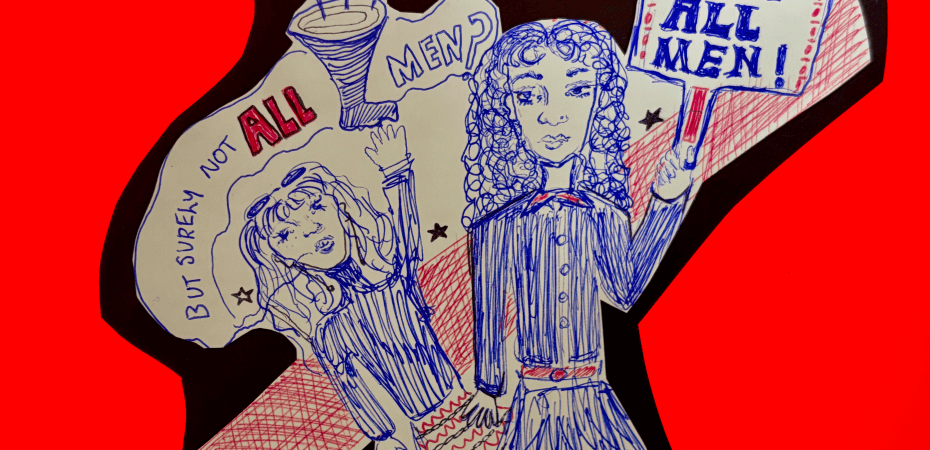
Annie Archer discusses the controversy behind the phrase ‘I hate men’, exploring the social realities that inform it and its impact on discussions surrounding gender and safety.
“I Hate Men.” Maybe your friend has just had a bad experience with a sexist guy – “ugh, I hate men!”, you console her. Or, you get catcalled as you’re walking down the street – “gross, we hate men!”, we groan. It’s a phrase which seems to be increasingly being thrown around in casual conversation, much to the indignation of the male population – “not all men!”, they cry. And no, it’s not all men, but when all women have had some kind of bad experience, is it not safer to assume the worst?
Imagine you’d been attacked by a shark. You would probably be scared of sharks for the rest of your life. You’d probably also warn other people about the dangers sharks pose. Now, you’re aware that not all sharks want to attack you but, for the sake of your own safety, you’d view them all with the same sense of fear, right?
French writer, Pauline Harmange titled her controversial 2020 essay ‘Moi les hommes, je les deteste’ (translating to ‘I Hate Men’). In her piece, she discusses ‘hating’ men as a valid response to the patriarchal oppression of women. While her views are extreme, they sparked an important debate around women’s responses to male violence and oppression. Although the phrase is sometimes used jokingly – albeit a sort of dark-humoured, don’t-laugh-you’ll-cry joke – the reality is far from a joke.
In July 2024, the UK government declared violence against women and girls (VAWG) as an ‘epidemic’ after the National Police Chiefs’ Council reported that one million VAWG crimes were recorded during 2022/23, accounting for 20% of all police recorded crime. At least one in twelve women will be a victim every year, with the exact number expected to be much higher due to unreported cases. These studies reveal terrifying facts, like that you’re far more likely to be assaulted by someone you know than by a stranger. High-profile cases like Sarah Everard and Gisele Pelicot, remind us of the very real threat that persists in modern society.
Ok, so the fears are valid. But does the phrase only cause further division? Feminism shouldn’t only be a women’s issue. Firstly, men actually need feminism just as much as women do – because, no, contrary to popular belief, issues like men’s mental health and toxic masculinity are not a secret plot created by women- they too are products of patriarchal systems. Could using this phrase only cause further division and the alienation of allies?
Equally, feminism should be intersectional and completely inclusive to the transgender community, who face both misogyny and transphobia. The recent change to legislation regarding access to gendered spaces was supposedly an attempt to ‘protect women’, but as trans activist Bel Priestley puts it in an interview with Jamie Laing, “trans women aren’t the problem!” In fact, trans women equally need to be protected from men. Studies have found that trans women are “often unsafe when accessing male-designated spaces yet systemically excluded from female-designated facilities”. It seems bizarre and unfair that trans women are the ones being affected by laws, rather than the statistically proven threat – men.
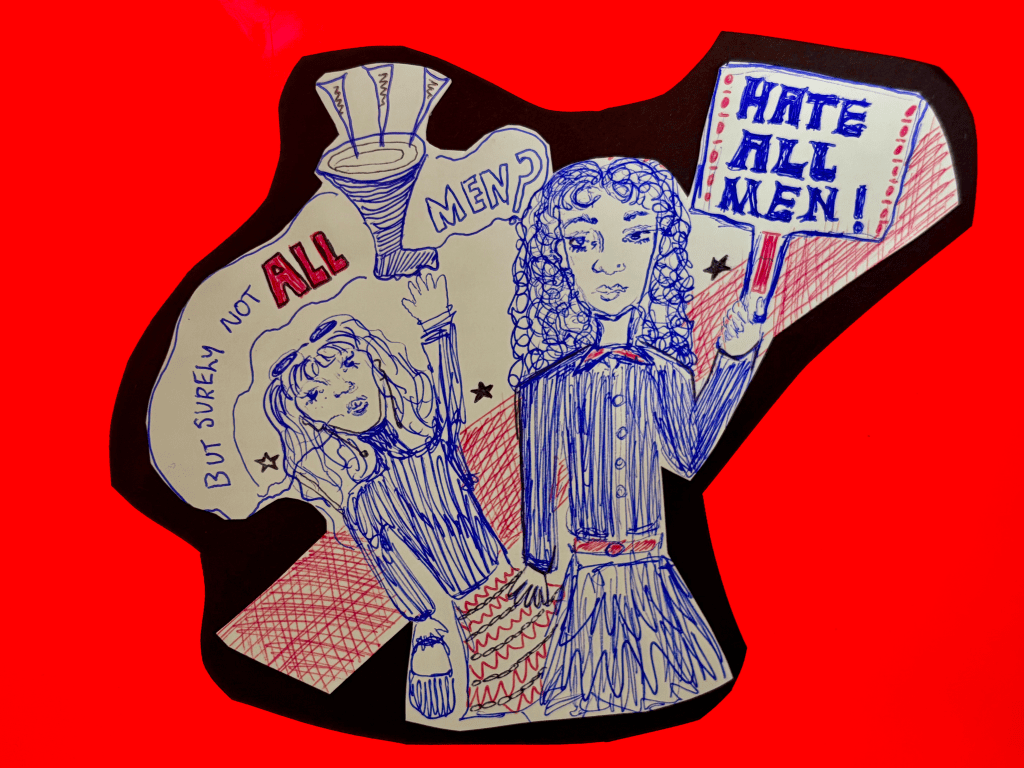
We can see, though, how saying “I hate men” could suggest quite rigid gender roles and create the potential for those who don’t fit traditional binaries to get lost in the middle. Feminism is not just for cis-women but for all people who experience gender-based oppression. Should we worry that saying “I hate men” could reinforce binary gender division, lead trans people to feel excluded or misunderstood in feminist spaces, or give an excuse for further restrictions to be put on trans rights under the guise of ‘protecting women’?
Do I think spreading hate is the most productive route? No. Do I think it’s ideal to generalise all men together? No. But do we live in a world where it is scary to be a woman? Yes. It seems that every woman knows someone, or is someone, who has been abused, assaulted, harmed, oppressed, or shamed by a man. It’s heartbreaking once you start speaking to the people around you and you come to realise that these events are not one-offs. So no, while we don’t literally hate every single man on the planet, we can begin to understand how this consensus of ‘hate’ is brewed out of fear and anger.
It’s not up to me to say whether the phrase is or isn’t acceptable. But I think we shouldn’t be so quick to condemn women for simply responding to fear. Women are angry, the oppressed are angry. And if you’re a man whose first response to “I hate men” is “not all men”, maybe instead start to think about what you can do to help. Perhaps volunteering at a domestic violence charity, or simply calling out misogyny when you hear it. Then hopefully, one day, no one will have to ‘hate’ anyone.
National Domestic Abuse Helpline: 0808 2000 24; https://www.nationaldahelpline.org.uk/
Women’s Aid: https://www.womensaid.org.uk/
CALM: 0800 58 58 58
Bristol Mind: 0117 980 0370
The Bridge: 0117 3426999
 That's What She Said Magazine