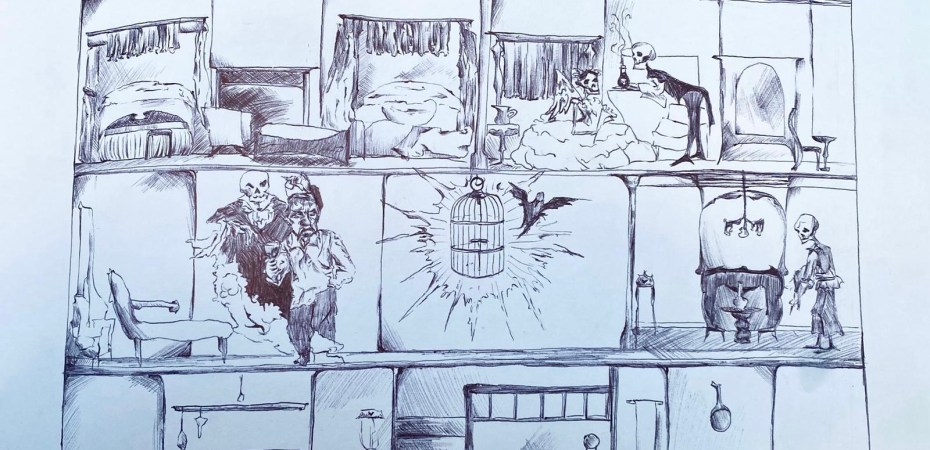
Simren Jhalli explores how women trapped in domestic spaces in the 18th and 19th centuries have expressed rebellion through literature, poetry, and, in extreme cases, the use of arsenic to reclaim agency.
Throughout history, the domestic sphere has been seen as a woman’s world – a space to polish both their virtues and their silverware. In comparison to the freedom men granted themselves, the private spaces women inhabited became a prison for many, silenced by the nurturing role placed upon them. Since the dawn of industrial and social reform in the nineteenth century, much has changed, yet progress is never universal.
To understand this long entrapment, we must not only look at laws or customs, but at stories: the art, literature, and myths that have quietly reinforced, or resisted, these boundaries. In this article, I want to bring you into a world where metaphor meets method, from the “Angel in the House” to The Angel-Makers of Nagyrév. I will weave together poetry and poison to show how women, trapped within domesticity, sometimes found liberation in the very tools meant to destroy.
If you were an A-level English student like me, you will recognise the texts that quietly warned us about this suffocating order. In Henrik Ibsen’s A Doll’s House (1879), we meet Nora, the archetypal wife, fluttering through the rooms of her home like a brightly dressed canary. Ibsen’s work sits firmly within the ideological shadow of Coventry Patmore’s The Angel in the House, where a woman’s sole virtue was her obedience. Nora dances the Tarantella at her husband’s command – an image that is both charming and tragic – performing not only a dance, but her own submission. The entire play takes place within the living room, a symbolic stage-cage that reflects her spiritual confinement.
Ibsen’s conclusion shocked his Victorian audience: Nora leaves. She steps into the cold night, an act of heresy and rebirth. In some modern reinterpretations of the play, directors heighten the subtext: Thomas Ostermerier’s striking version ends with Nora shooting her husband (2002), a symbolic rupture that exposes the violence simmering beneath years of repression. Whether literal or metaphorical, this moment represents the slow, dangerous alchemy of a woman turning endurance into rebellion.
Christina Rossetti, writing slightly earlier (1830-1894), translated this tension into verse. Her poetry explores the quiet despair of women whose worth was tethered to marriage and motherhood. In “Maude Clare” (1862), Rossetti presents a jilted woman confronting her former lover on his wedding day, her anger simmering just below the surface, her language deceptively restrained. “Take my share of a fickle heart, / Mine of a paltry love,” she declares, handing over her bitterness like a cursed gift. Rossetti’s tone is devotional yet defiant; her piety masking something perilously close to rage.
Fast forward a century, and the tone shifts, but the battle remains. Nora Ephron’s Heartburn (1983) turns marital breakdown into comedy, but the humour is acidic. Her protagonist, Rachel, discovers her husband’s infidelity and must decide whether to preserve the illusion of domestic wholeness or embrace single motherhood. She chooses freedom and, fittingly, revenge through storytelling. The poison of the past gave way to Ephron’s sharp wit; both are potent forms of survival.
Agatha Christie would later distil this same unease into something more chillingly domestic. The Pale Horse (1961) follows a group of women who run what appears to be a quaint village séance circle, only for it to emerge that their “spells” are in fact a cover for systematic poisonings. Christie transforms the seemingly quiet hum of domestic life into a site of danger and control – a modern echo of the same desperation that once simmered behind lace curtains and locked doors.
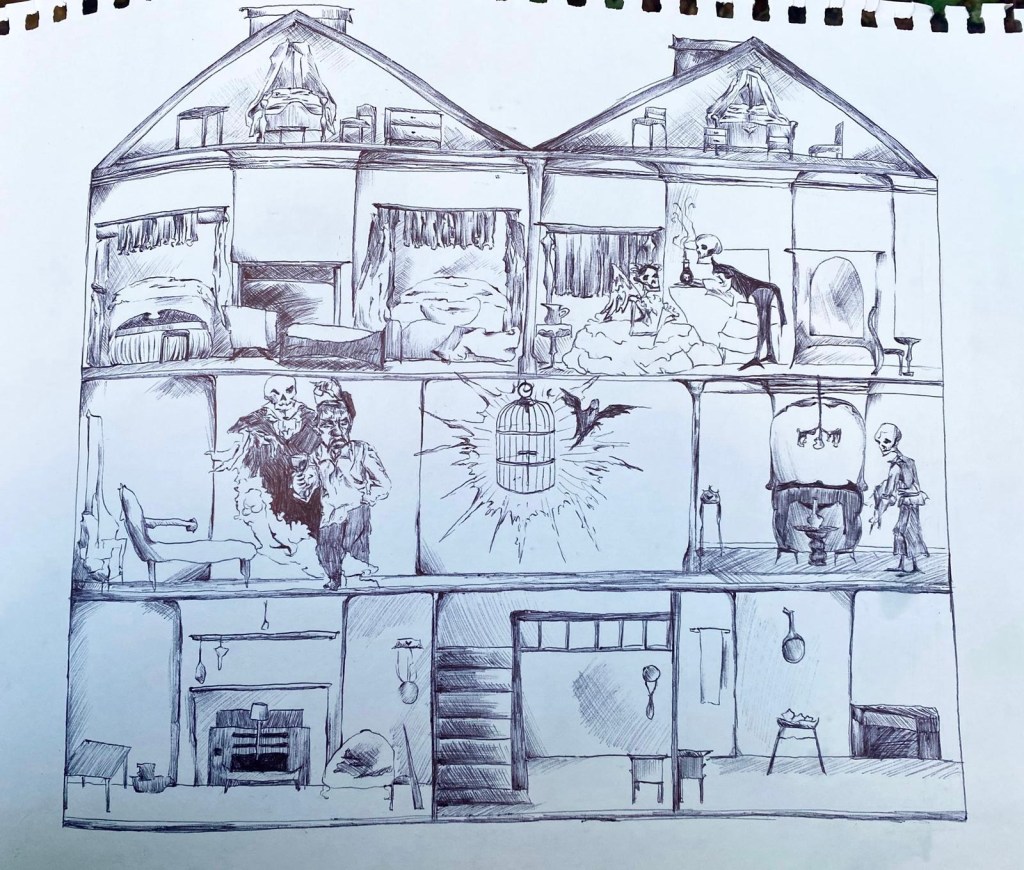
But before women could write their way out, and long before divorce was a legal recourse, their methods were more final – quite literally. In seventeenth and eighteenth-century Europe, a series of so-called “poison panics” swept through towns and courts as authorities realised that arsenic– a silent, invisible killer– had become the weapon of choice for the desperately trapped, for whom the marriage contract was a life sentence.
Arsenic was everywhere: derived by metal production and sold cheaply by grocers and chemists alike. It was tasteless (“only faintly sweet,” as toxicologist Robert Christison famously discovered after daring to taste it himself) and nearly indistinguishable from the diseases that plagued unsanitary homes. A spoonful in a home-cooked meal would easily go unnoticed, and a cruel husband might succumb to what seemed like a common stomach ailment.
Arsenic was the perfect domestic weapon, as invisible as women themselves were meant to be.
Yet what began as isolated acts of desperation gradually became something more deliberate. Across Europe’s small towns, whispers of recipes, remedies, and “women’s powders” disguised as make-up circulated quietly through kitchens and markets. The domestic sphere, always a site of shared knowledge between women, became an operating ground for chemical liberation. It was out of this hidden tradition that one of the most haunting episodes in twentieth-century Europe emerged.
In the village of Nagyrév, Hungary, in the early 1900s, a group of women known as The Angel Makers began to teach one another how to prepare and administer arsenic, often extracted from flypaper. Their victims were abusive husbands, unwanted fathers-in-law, or oppressive patriarchs. This was not mere murder; it was a communal rebellion, a dark sisterhood of alchemy forged to gain liberation.
And perhaps this is where the idea of women in alchemy finds its truest form. For centuries, alchemy promised transformation: of base metal into gold, of pain into power. For these women, the transformation was both literal and symbolic. They used the threads of knowledge available to them in their domestic spaces – herbs, powders, potions – to reclaim a form of agency in a world that denied them everything else.
Their stories remind us that rebellion is not always blaring. Sometimes it whispers. Sometimes it is measured out in teaspoons.
 That's What She Said Magazine