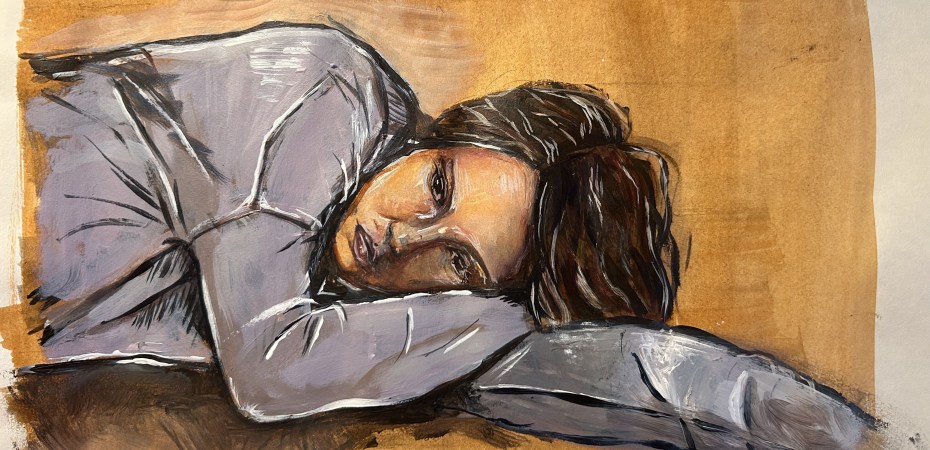
Scarlet Richards explores the sly curiosity and obsession with women’s mental health journeys, calling for society to focus on the cause rather than the spectacle.
It’s a well-worn trope: the tragic woman, consumed by suffering, her pain transformed into a form of art, a cultural currency. From the silver screen icons of old Hollywood to the tortured souls of modern pop culture, we have long been captivated by women’s struggles—turning their trauma into something both beautiful and commodifiable. Whether it’s Marilyn Monroe’s fragile image, Sylvia Plath’s mental anguish immortalised in her novel The Bell Jar, or Amy Winehouse’s deeply human struggles with addiction, we watch, we listen, and we consume. Yet, as we revel in these tragic narratives, we rarely stop to question the ways in which society profits from—and diminishes—these women’s real, lived pain. In a world that claims to prioritise well-being, why do we still find ourselves romanticising female pain, turning it into a tragic performance rather than addressing its roots?
The glorification of female suffering, particularly in the domains of art, music, and media, has long been an aesthetic. But, behind these performances lies an uncomfortable truth: when a woman’s anguish is commodified, it risks being depersonalised. A well-timed tear, a poetic death, or a melancholic melody can be beautiful—but it is also a spectacle, one that distracts us from addressing the systemic issues that allow such suffering to persist. The “beautiful tragedy” narrative reaffirms a dangerous cultural fixation on the fragility of women, while undercutting the more complicated realities of their lives.
This type of reaction to female pain is not only a contemporary issue, but one that predates social media and the trends of aesthetics that we see so often. Marilyn Monroe, a successful actress whose tragic personal life often overshadows her career, has been turned into a fragile, doomed, feminine figure. Elton John’s 1973 song Candle in the Wind immortalised her as a fleeting, delicate figure doomed by fame – ‘And it seems to me you lived your life like a candle in the wind,
Never knowing who to cling to when the rain set in’. Even in recent years, Andrew Dominik’s Blonde (2022) was criticised for depicting her suffering in a way that felt more exploitative than empathetic. These narratives frame her as a passive victim rather than acknowledging her agency, reinforcing the idea that women’s suffering is more memorable than their success.
Amy Winehouse’s legacy has been shaped as much by her struggles as by her talent. A woman now perceived as ‘tragic’ by the media and those who consume the depictions of her suffering, feeds into the narrative of the ‘tragic artist,’ making her personal pain a spectacle rather than a real crisis that needed support. This aestheticization of female struggle is an ongoing trend, extending even beyond mental health narratives. Frida Kahlo, for example, is often remembered primarily for her physical suffering, romanticised through interpretations of her work—while her radical political activism is frequently overlooked. By focusing on her as a symbol of suffering rather than an artist engaged in social justice, her legacy is softened, her political impact diminished. In both cases, their pain is commodified, repackaged for public consumption, while the deeper realities of their lives and work are sidelined.

This “beautiful tragedy” narrative turns a woman’s suffering into an aesthetic seen as poetic and meaningful, even if it remains disconnected from the reality of the pain involved. Society often admires and commodifies from this type of experience, reducing these women to their pain; objects that can be capitalised on instead of humans who are in need of real support. Today, brands and media companies profit from selling female suffering as an aesthetic. While past female artists often had their pain misinterpreted or exploited, today’s industry increasingly markets sadness as a product—where vulnerability is not just expressed but packaged and sold. Products are created that capitalise on “tragedy”—whether through fashion, music, or beauty. For example, the “Sad Girl” trope capitalises on melancholic imagery, selling a lifestyle that romanticised pain rather than addressing its root causes. Popularised in part by figures like Taylor Swift in her song The Archer and Lana Del Rey in her album Born to Die, this aesthetic taps into a culture that finds beauty in self-destruction. The early 2010s Tumblr culture and its embrace of quotes from Sylvia Plath and Virginia Woolf—often taken out of context—reinforced the notion of female pain as something artistic or deeply meaningful.
More open discussions around mental health, therapy, and self-care have created space for more nuanced conversations about women’s emotional well-being. Celebrities like Lady Gaga and Selena Gomez have started to speak openly about mental health without glamorising suffering, offering a more grounded narrative around recovery and resilience. However, while there is a growing trend of self-care and emotional resilience, the ‘soft girl’ aesthetic often repackages the same themes of fragility and sadness—now wrapped in pastel colours, delicate tears, and melancholic music. The irony is that even as we promote healing, the image of the fragile, sorrowful woman persists. Instead of glorifying destruction, we now romanticise a quiet, wistful kind of sadness—one that is palatable, beautiful, and aesthetically curated for social media. There’s pressure to present recovery as a neat, visually pleasing process rather than the messy, nonlinear journey it truly is. In this way, suffering is still commodified, just in a softer, more marketable form.
To truly move past the romanticisation of female pain, society must focus on women’s talents, intelligence, and complexity rather than fixating on their suffering. We should aim to celebrate resilience and the multi-dimensionality of women, shifting the focus from tragedy to empowerment. Media and audiences should prioritise stories of strength, creativity, and resilience in women—stories that acknowledge pain but don’t reduce women to their suffering. The challenge is to create new narratives where pain is not commodified or romanticised but addressed with the respect and seriousness it deserves.
 That's What She Said Magazine