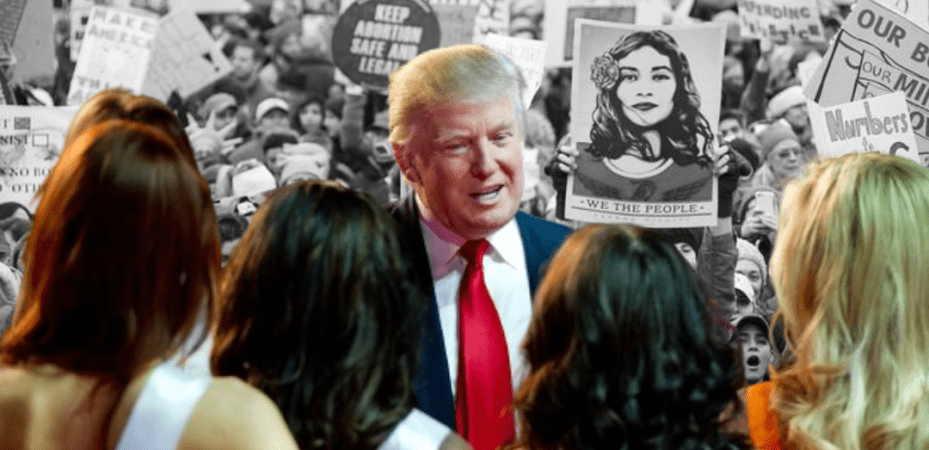
Alice Graham examines the future of women and LGBTQIA+ people in America under Donald Trump’s second term of presidency.
During his presidential campaign, Donald Trump pledged to ‘protect’ women ‘whether [they] like it or not’. But, come his inauguration in January 2025, what can women and the LGBTQIA+ community really expect? Considering the efforts Trump made in his first administration to ‘roll back women’s rights’, there are mounting concerns that his second term will be no different. Trump’s recent cabinet nominations, including ultra-conservative Pete Hegseth who has ‘questioned the role of women in combat’, could indicate that Trump’s second administration ‘will lead to an extremist agenda’ with harsher policies on all fronts. Clearly hearing the sexist undertones in Trump’s promise of protection, it is hard to imagine a change in Trump’s gender-politics.
Spread of Sexist Attitudes
Above all, we can expect the spread of misogynistic attitudes within America. The election of Trump, a convicted felon who faced multiple sexual misconduct allegations and uses an evidently sexist rhetoric, encourages the normalisation of misogyny. It sends a message: if the president can, why can’t I? The proliferation of Trump’s online sexism has launched him to fame in the ‘manosphere’ (a range of online forums and websites uniting men who feel disadvantaged by society as a consequence of the influence of feminism). Within these online communities, Trump’s sexist attitudes are used to endorse the men’s existing misogynistic beliefs. Since Trump’s recent feature on Joe Rogan’s podcast, his popularity has only grown – not only within the ‘manosphere’ but also in young men more generally. And the consequences are already visible, with a surge in online misogyny reported since Trump’s re-election both within America and internationally. Considering how manosphere influencer Andrew Tate’s misogyny translated quickly from online to offline, it is easy to see how the similarly sexist attitudes of Trump might be carried into reality by his followers. Beyond this, Trump’s attitudes might permit the development of global sexist policies, especially concerning reproductive rights.
Reproductive Rights
Though Trump claims that he would ‘not support a federal abortion ban, under any circumstances’, his nonchalance towards individual state choices on the matter reveal his indifference towards the agency and reproductive rights of women. When Trump states ‘it is up to the states to decide based on the will of their voters’, he allows female agency to become a matter of public discretion. Worryingly, he believes the overturning of Roe v Wade is a triumph for democracy: he boasts ‘we broke Roe v Wade. Nobody thought that was possible. We gave it back to the states’. Under the guise of public choice, Trump has encouraged the removal of female personal agency – since abortion was removed as a constitutional right in 2022, ‘nearly two dozen US states have banned or limited access to [abortion]’. Despite expectations of restricted reproductive freedoms, we can remain hopeful that limitations might be mitigated by the influence of female rights groups and world leaders. The Center for Reproductive Rights is just one charity determined to fight anti-abortion laws and leaders of the UK, Canada, France and New Zealand have previously condemned the US Supreme Court’s Decision to remove abortion rights from the constitution.

Lack of Support for the LGBTQIA+ Community
Often inconsistent in his public views on LGTBQIA+ issues, Trump has historically shown both support for and opposition to matters such as same-sex marriage and transgender bathroom usage. However, during his presidential campaign, Trump has extensively used anti-trans rhetoric as well as claiming he would ‘punish doctors who provide gender-affirming care for minors and impose consequences for teachers who discuss it with students’ in 2023. It is uncertain what stance Trump might take on these issues once inaugurated, but his fluctuating beliefs mark him as an unreliable ally to the LGBTQIA+ community.
The signs are clear: we can’t trust Trump to ‘protect’ women and the LGBTQIA+ community. Despite his bold promises to women, Trump’s ignorance of the real issues faced by this demographic are evident in his sexist remarks and unprogressive views, and ironically summarised in his quote: ‘I’m going to protect [women] from migrants coming in. I’m going to protect them from foreign countries that want to hit us with missiles and lots of other things’. For women and the LGBTQIA+ community, the future under Trump’s second term as president seems bleak but there is hope and strength to be found within pro-rights groups and the backlash already being actioned against Trump’s misogyny. Within Bristol, similar protests have erupted both at the University of Bristol and within the wider community. As Trump’s influence grows overseas, it is important to consider our own agency within the UK and remember the importance of collective resistance and solidarity with those in the US disappointed by the election results.
 That's What She Said Magazine