
Erinna Mannan shares her perspective on the fashion industry’s complicated relationship with feminism, unpacking public response and designer intention.
Fashion and feminism are constantly intertwined as enemies and lovers. In our fast-paced, consumerist world, it’s easier to be blind to the morals of fashion and its implication on women. Ranging from designers like the punk icon Vivienne Westwood to the controversial Karl Lagerfeld, fashion houses have presented women in vastly different lights with different beauty standards. In her book French Lipstick: Redressing Fashion and Feminism, Linda Scott elucidates, ‘the ability to control what is fashionable is a form of power women wield over each other’. But are fashion and feminism compatible? Have we been sold a false vision of feminism in the name of company profits?
Since the early 1900s, women’s fashion has been targeted at slim, stereotypically attractive women. This peaked in the 90s with the rise of heroin chic, and even today most well-known supermodels fit perfectly into Eurocentric beauty standards: Kendall Jenner, Gigi Hadid, and Cara Delevingne, to name a few. However, certain designers have redefined femininity in their collections.
We can see how this beauty standard has become ingrained through backlash against Victoria’s Secret’s runway shows. Victoria’s Secret is renowned for its striking, slim models (hence the term ‘Angels’), and it’s fair to assume that many young girls have idolised these models. Yet, with the inclusion of more body types, many VS fans have criticised what they refer to as ‘a drop in the standard’. I was shocked to see how little viewers appreciated the diverse body-types. However, the disappointment voiced by thousands of VS fans have also claimed that the excellence of the runways and collections have significantly dropped. While I will always vouch for VS’s inclusion of a different body, it must be done to the same standard as a company’s previous works; otherwise it is not body positivity, but a publicity stunt. We should also note that VS is owned by men, designed for by men, and caters to the male gaze.
With this said, it would be a disservice to discuss fashion without mentioning Karl Lagerfeld, who revived Dior and Chanel. His armoury of work and achievements is undoubtedly impressive and he transformed the world of fashion into how we currently know it. However, is it not questionable for a rich white man to hold so much power over the female image in fashion? This question came into the limelight during the 2023 Met Gala which was dedicated to Lagerfeld’s legacy. Many celebrities and spectators criticised Lagerfeld for his alleged fat-phobia and his rhetoric on how women should be presented.
Lagerfeld has also faced controversy for his Chanel Spring 2015 Runway, which featured the models marching down the catwalk with protest banners, referencing the student protests of 1968. Slogans on the banners included ‘Boys Should Get Pregnant Too’, ‘Tweed Is Better Than Tweet’, and ‘Be Your Own Stylist’. Although this feminist demonstration inspired some, many others referred to it as ‘feminist snake oil’ and were irritated by Lagerfeld’s blasé attitude towards feminism. Lagerfeld defended himself (or at least tried to) by stating that his mother was a feminist and, in his opinion, feminism should be lighthearted. Not only does Lagerfeld undermine the importance of feminism, but he exploits it to gain publicity. There is also a bitter irony about dozens of stereotypically attractive women – women who do not represent the majority – marching on a runway under the command of a privileged and powerful man. Not a shred of intersectionality is anywhere to be found: ‘It’s Karl Lagerfled’s Joke, and Feminism isn’t in on it’.
Feminism has also been explicitly incorporated with fashion but with questionable motivations. Maria Grazia Chiuri, the designer for Dior, released a collection of T-shirts with the slogan ‘WE SHOULD ALL BE FEMINISTS’ imprinted on the front. Another shirt read ‘THE FUTURE IS FEMALE’’. Both of these shirts retail at $920 each. Evidently, the price emphasises the financial motivations of large fashion houses like Dior. With the rise of fourth-wave feminism, this collection took to the runway at the perfect time to grab widespread attention. Thus, with self-serving motivations, it is hard to believe these shirts are feminist at all. Instead, we can deduce that this collection adopts the term ‘feminism’ in an attempt to engage with a larger demographic and boost sales – also known as pseudo-feminism.
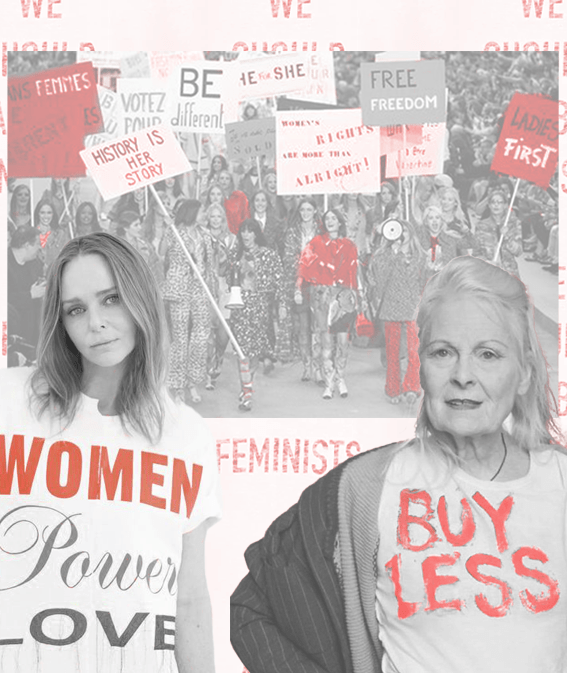
However, not all designers are exploiting feminism to boost revenue. Stella McCartney meticulously embeds feminist visions into her collections. McCartney partnered with Glamour Magazine to create a shirt with the words ‘WOMEN Power LOVE’ plastered on the front. How is this different from Dior’s shirts? McCartney’s design was solely created to feature on the cover of Glamour Magazine to celebrate the successes of women, not to generate revenue. McCartney received a lot of criticism for her sustainable goals at the start of her career, but her iron determination triumphed. She prides herself on her clothes being structured, but not constrictive like much of women’s fashion has been. McCartney reminds us that high fashion can be sexy and comfortable. Not to mention that her clothes actually have pockets!
To say Vivienne Westwood challenged the notions of femininity would be an understatement. Westwood always held feminism and human rights close to her heart and incorporated this into her fashion. Many of her pieces and models were gender-fluid. She and her models sported harsh makeup, vibrant hair, and ostentatious outfits. In her early career, Westwood’s collections were aimed at rock and punk enthusiasts – those who disagreed with capitalism and the general state of the world. I and many others love Vivienne Westwood because she would not make women palatable for the rest of society. Instead, she endorsed a rougher, more independent form of femininity.
Currently, the fashion industry is being yanked in different directions and with today’s social and environmental crises, the future of fashion is uncertain. Fashion has catered to women from the beginning; where there are women, there is feminism. So, where do we go from here? It seems to me the only solution is pushing for intersectionality and holding big companies accountable. We are all consumers, and therefore wield enough power to make a change in one of the largest, most pertinent industries in the world.
 That's What She Said Magazine