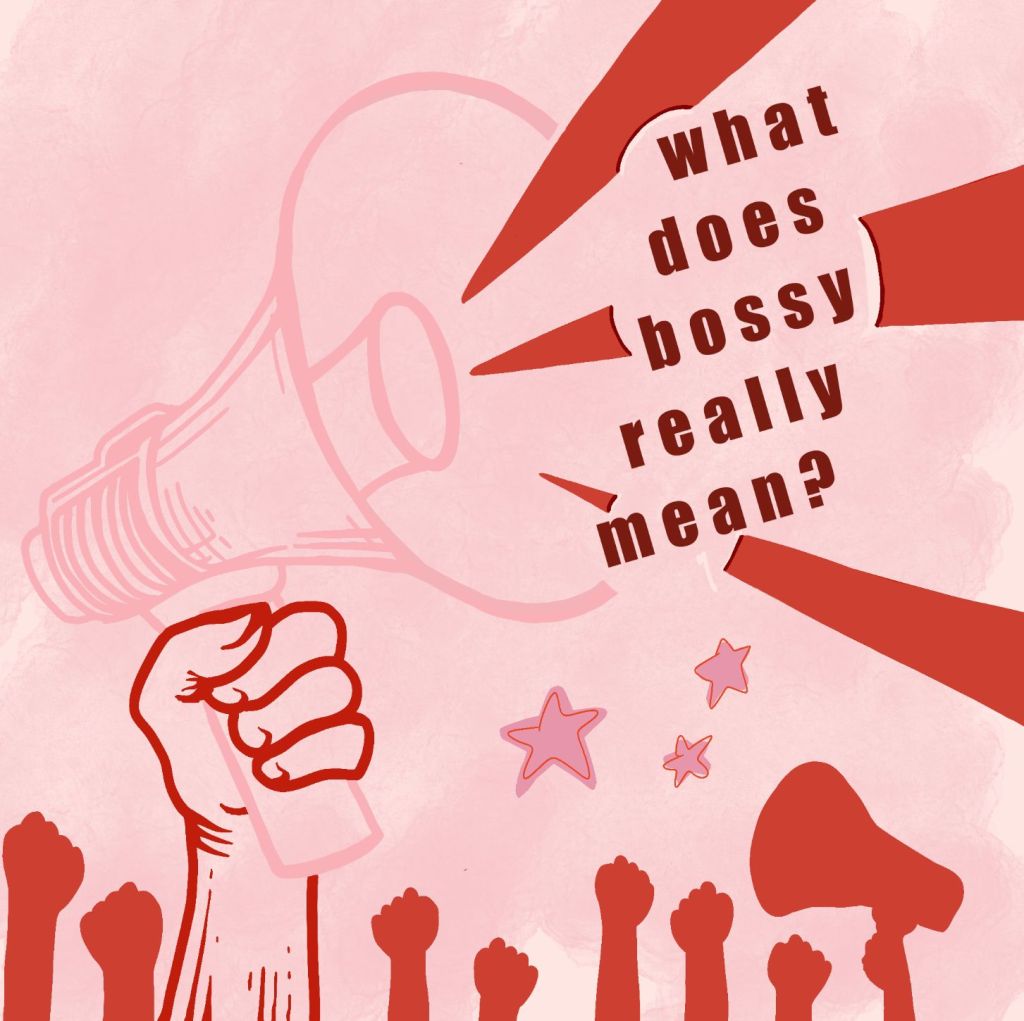
Sofia Lambis unpacks the word ‘bossy’, and how much this word represents attitudes toward female leadership in our society.
Language shapes our perceptions and arguably influences how we are treated. Recently, while having coffee with a friend, she mentioned that her old school reports would label her as ‘bossy’, and her like-minded older brother as a ‘leader.’ In the Merriam-Webster dictionary, ‘bossy’ is defined as someone who is ‘dictatorial’ whilst ‘leader’ is ‘a person who has commanding authority or influence’. Clearly, there is a subtle difference between the two, with the former having far more positive connotations than the latter. So, why were two children who shared the same personality trait described differently? This made me consider all the words that are used almost exclusively to describe women, and what impact this selective use of language could have on us. What happens when these words move out of school reports, and start being used in everyday life?
Let’s take the first example. ‘Bossy’ vs ‘leader’. Leader implies authority, control, shared goals, forward-thinking. Bossy infers an annoyance, an aggravation. It is also a very female-coded word. The girl organising a game of hide-and-seek is ‘bossy’, the CEO with a briefcase and high-heels is ‘bossy’, the PE teacher shouting instructions is ‘bossy’. It is seldom used to describe men. As we can see from the example above, these two words have in the past been used to reference the same quality. Perhaps the terms themselves tell us little about the people being referenced, and far more about how their attempts at leadership are perceived. There is a lack of respect associated with ‘bossy’ – the term largely coded as feminine that is nonetheless present with ‘leader’. As a term, ‘bossy’ is demeaning and silencing. Used by children and adults alike, it perhaps speaks to a culture uncomfortable with female authority. Professor Deborah Cameron, who specialises in sociolinguistics and linguistic anthropology describes this language as a form of ‘social policing.’ The consequences are discouraging – women may fear losing the respect of their colleagues and peers, and not being taken as seriously as they ought to be. Going even further, examining the way women’s voices are described in the English language can lead us to an understanding of how they can be perceived. Once you examine these words, it’s hard not to keep noticing them. Shrill versus booming. Aggressive versus assertive. And of course, the crown jewel of women’s adjectives – hysterical. In her seminal essay collection Women and Power (originally delivered as a series of lectures) Mary Beard explores ‘how we have learnt to hear authority’. There is no reason for a high voice to be considered any less authoritative than a lower one. Shrill should carry no less authority, no less judgement, than booming. Perhaps we should consider why so many words used to describe authoritative women are bound up with ideas of annoyance and irritation?
Even in their old age, women are unable to escape this coded language. One only needs to type the word into a thesaurus’ search bar before being hit with hag, crone, biddy and sourpuss. Again, these words are often used in the context of undermining someone, usually (or, let’s be honest, exclusively women). Such a varied, colourful list of words, to which I struggle to find satisfactory male equivalents. Fortunately, people are not only becoming aware of these unnecessarily gendered words, but are actively combating them. In 2020, Maria Beatrice Giovanardi petitioned for the Oxford English Dictionary to change its definition of a woman, as bitch, wench and biddy were all listed as synonyms. Offered without context, these words reinforce gender stereotypes and centre men.
Moreover, listed under example uses of woman was the phrase ‘I told you to be home when I get home, little woman.’ Deborah Cameron suggested that modern dictionaries reflect modern uses of language, so the OED’s inclusion of these words exposes our sexism and biases. It offers a stark insight into how distaste for (and even fear of) female authority has seeped into our language. Despite this, Cameron questions why dated words such as ‘filly’ and ‘petticoat’ have a place in the OED as they are no longer fixtures of modern language.
Interestingly, Cameron also pointed out that the definition of the word man was itself broader than the word woman, as the former can be used to describe humanity as a whole whilst the latter merely refers to a subsection of it.
A lot can be learnt (and unlearnt) when looking at whom certain words are used to describe. It seems that a whole section of the English language’s unfavourable words are targeted exclusively towards women. Hopefully, when we start looking more closely at the language we are using we’ll start to adapt and change it, so that young girls can be described and uplifted as ‘leaders’ instead of labelled simply ‘bossy’.
 That's What She Said Magazine