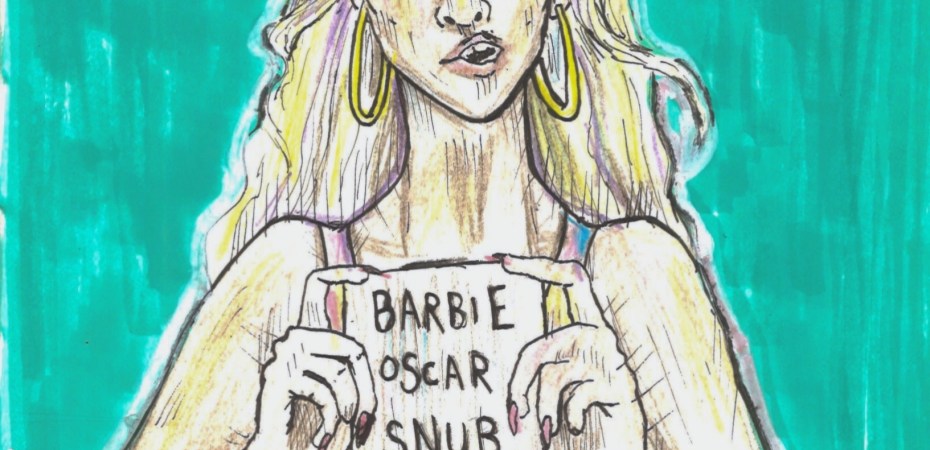
Reflecting on this year’s awards season (and slightly delayed due to exam season!) Eve Davies discusses the cultural phenomenon of Barbie’s Gerwig and Robbie being snubbed at the Oscars, suggesting that we should be celebrating the successes of women and minorities who deserve the spotlight more.
Unless you’ve been trapped in a plastic doll box, it’s unlikely you’ve escaped the ‘Barbie-mania’ that’s overtaken the globe. Paired with an overtly pink marketing campaign and an album of summer hits featuring the likes of Billie Eilish and Charli XCX, the Barbie movie was a blockbuster smash.
Of course, the impact of Barbie (2023) transcended mere box office numbers. It became a cultural phenomenon, resonating with audiences across generations. Watching the film with my mum, clad in pink dresses and audacious pink eyeliner, was one of my favourite summer memories. Barbie was a nostalgic journey, evoking memories of childhood playtime and coming of age. Despite the film’s commercial success, director Greta Gerwig and lead actress Margot Robbie were notably absent from the Oscar nominations in their respective categories. This has sparked outrage online, with many labelling the Academy’s decision as misogynistic. But is there merit to these claims, or do they oversimplify a complex issue?
While the film undoubtedly made waves at the box office and resonated with audiences, the argument for Gerwig and Robbie’s inclusion in the nominations falls short upon further examination. Greta Gerwig’s direction, while commendable in capturing the nostalgic essence of the iconic doll, could be seen to lack the innovative and transformative qualities typically associated with Best Director nominees. Critics of Gerwig’s snub argue that it reflects a broader gender bias within the Academy. However, it is important to recognise that the Oscars adhere to a specific set of criteria, often favouring certain genres and narratives – traditionally historical drama or biopic. While Barbie may have resonated with general audiences, its deviation from conventional Oscar fare may have influenced the nomination process.
Likewise, while Robbie’s depiction of Barbie was emotionally stirring, it was hardly a groundbreaking performance deserving of an Oscar nod. A comparison with her previous roles, particularly her portrayal of Tonya Harding, reveals a stark contrast. In I, Tonya (2017), Robbie delivered a performance that was notably more compelling, emotionally charged, and daring – rightfully earning her a Best Actress nomination in 2018. Robbie was great in the role of Barbie, but it doesn’t demand much from her. This year’s competition in the Best Actress category was exceptionally fierce, leaving Robbie overshadowed by other remarkable performances. Emma Stone’s bold and subversive role in Poor Things (2023), for example, showcased a depth and complexity that was absent from Barbie. Moreover, the sole focus on Robbie’s performance overlooks her significant behind-the-scenes contributions. While her omission from the acting categories may be disappointing to some, it’s crucial to recognise the multifaceted nature of her involvement in the project. Margot Robbie not only starred in Barbie but also served as an executive producer, actively campaigning to bring the project to fruition. As such, she is rightfully recognised with a nomination for ‘Best Picture’.

Additionally, the nomination of Ryan Gosling for Best Supporting Actor has drawn scrutiny. While the character’s relationship with Barbie is integral to the film, it is important to note that he is not the lead actor and thus cannot be equated with Robbie. Indeed, America Ferrera – in her portrayal of Gloria – did receive a nomination in the corresponding female category. Ferrera’s nomination underscores the diversity of talent within the cast and challenges simplistic narratives of gender bias. It’s rather perplexing that Ferrera’s nomination has flown under the radar amidst the discourse surrounding Gerwig and Robbie, which unfortunately mirrors the trend for all nominations of women of colour this year. As Stacy Lee Kong noted in her article about the snubs, ‘Ferrera is a first-time nominee, the ninth Latina to ever be nominated for an Oscar and the first person of Honduran descent to be nominated in any category. I don’t love that we’re still doing that thing where we’re excited that it has taken 95 years for an industry award to recognize a person from a particular marginalized group, but you’d think nominating a woman of colour who was actually in the movie you’re going to bat for would be, I dunno, notable?’ This year’s Oscar nominations represent one of the most diverse selections ever, with people of colour acknowledged in every acting category. Beyond that, LGBTQ+ actors – such as Domingo and Jodie Foster – have been recognised for playing LGBTQ+ characters. Alexandra Koster aptly summarised, ‘When a white woman isn’t nominated, people lose it. But when people of colour defy the odds, they’re ambivalent.’
Furthermore, while Barbie may present itself as a feminist statement, its messaging falls short upon closer scrutiny. Despite attempts to address stereotypes and promote positive self-image, the underlying pro-consumerism of the Barbie franchise remains unchanged. The film’s resolution, featuring an all-male board of executives at MATTEL, undermines its purported feminist agenda. In essence, while Barbie may be a charming film, it ultimately fails to deliver on its promises of movement for feminist empowerment.
Despite this, the Oscars are supposed to reward excellence in the film industry. They are supposed to be artistic. While I think a lot of what we consider ‘art’ has been shaped by preconceived biases and older white men deciding what’s good, sometimes there are undeniably better films that have coincidentally been directed by men. However, this may be simply because there are more male directors and they have had more time and support to hone their craft. Barbie has been nominated for Best Picture, a nomination which justly reflects its cultural impact, and it should be acknowledged that not all films directed by women are inherently feminist masterpieces and shouldn’t be rewarded for the sake of it.
Perhaps, when we analyse individual performances and direction without considering commercial success, they are inferior to the other contenders of 2023/24. Ultimately, while the Oscar snubs for Barbie may have sparked controversy, the absence of nominations for Robbie and Gerwig reflects that their contributions were not necessarily worthy of Oscar recognition. While their efforts may have resonated emotionally and contributed to the film’s cultural impact, they ultimately fell short of the standard set by their peers. Gerwig’s direction, though adeptly capturing nostalgia, lacks the innovation and depth seen in previous Oscar-nominated works. Therefore, while Barbie may have left its mark on audiences, its absence from the nominations reflects a sober evaluation of its artistic merits, rather than any gender bias. As we continue to celebrate the achievements of women in film, it is crucial to recognise and reward excellence where it truly resides.
 That's What She Said Magazine