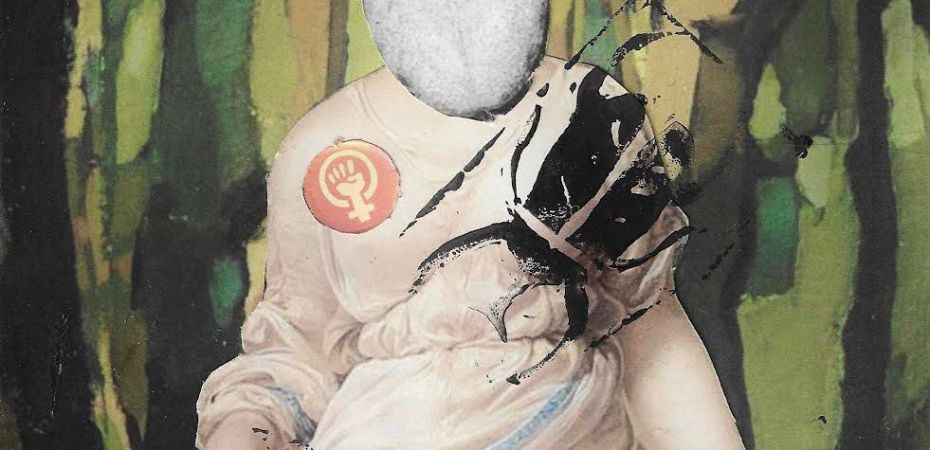
Lizzie Bickerstaff reshapes our view of the Banshee, reading through a feminist lens in order to embrace the legend as a figure of female empowerment and emancipation.
At the time of the banshee legend’s conception, women became culpable for unexplained phenomena, their insecure societal status making them perfect targets upon which to relieve supernatural anxieties. Looking beyond her role as the harbinger of death, the banshee exhibits a liminal quality that, upon further examination, reflects the deeply ambiguous nature of women’s ‘traditional’ place in society. While, ostensibly, tales of the banshee’s manifestation may enforce this ambiguity as malignant, I propose a reintroduction to this deeply misunderstood figure as reflective of the emancipated and empowered woman.
The act of marriage traditionally saw the woman move into the home of the husband, subsumed by the family unit and yet forever slightly removed due to her lack of blood relation. She was an outsider, an interloper and therefore considered a threat. Despite this, a contradiction arises in her indispensability to the survival and continuity of the family line. As mother and wife, she was expected to bear children, provide sustenance and maintain a suitable environment in which to raise the next generation. The inherent contradiction of the ‘traditional woman’, steeped in both threat and essentiality, bred an instability that, to their male counterparts, became an incomprehensible threat.
Historically, the functions of women within patriarchal communities are deeply rooted in their liminality. One needs only look to the midwife to discover centuries of women facilitating the passage between non-existence and existence – a negotiation of medial space that reclaims feminine ambiguity as a powerful device wielded in matters of life and death. By the same token the mnàthan-tuirim, or ‘keening women’ of Celtic communities, were integral intermediaries for the passage between our world and the next, expressing this navigation through wailing lament.
The banshee not only appears to negotiate liminal space but embodies the concept throughout her manifestations in the folk-canon. Her origins are frequently thought to be that of a displaced or ostracised woman. A theory from the Irish town of Kilkenny positions the banshee as a female spirit who has lost her family and forever mourns them, unable to transition from one plane to the next. In accordance with this folk-view the banshee is a mnàth-tuirim who has not found success in her role, forever mourning and, therefore, remaining in a transitional state that prevents her from societal assimilation. The banshee’s intermediary position is also apparent in the alleged times and locations of her manifestation: testimonies place the banshee at the twilight hours of day and night with her generally favoured time to wail being the midnight before an imminent death. Notably, the banshee is most reported to manifest at the thresholds or margins of a property, perhaps ankle-deep in the stream separating settlement and wilderness, or skulking at the threshold of the family home, wailing through a window left ajar.
It is upon the banshee’s distinguishing liminality, that I would level my proposal for her feminist reclamation. The banshee appears to manifest just beyond the parameters that physicalise a woman’s traditional place in patriarchal societies. Lurking outside the boundaries of domesticity, the banshee becomes a subversive foil to the housewife: the banshee refuses to assimilate with the domestic space and the housewife cannot overstep the bounds of her position within that space. We might conclude then that the banshee figure is in fact an encoding of the emancipated woman in traditional Irish society. The absence or loss of the family unit leaves the banshee free to embrace a powerful autonomy, avoiding a male imposition of domestic control. Through purposeful adoption of perpetual obscurity, the woman becomes wild, tramping the backwoods of the physical and gendered spaces.
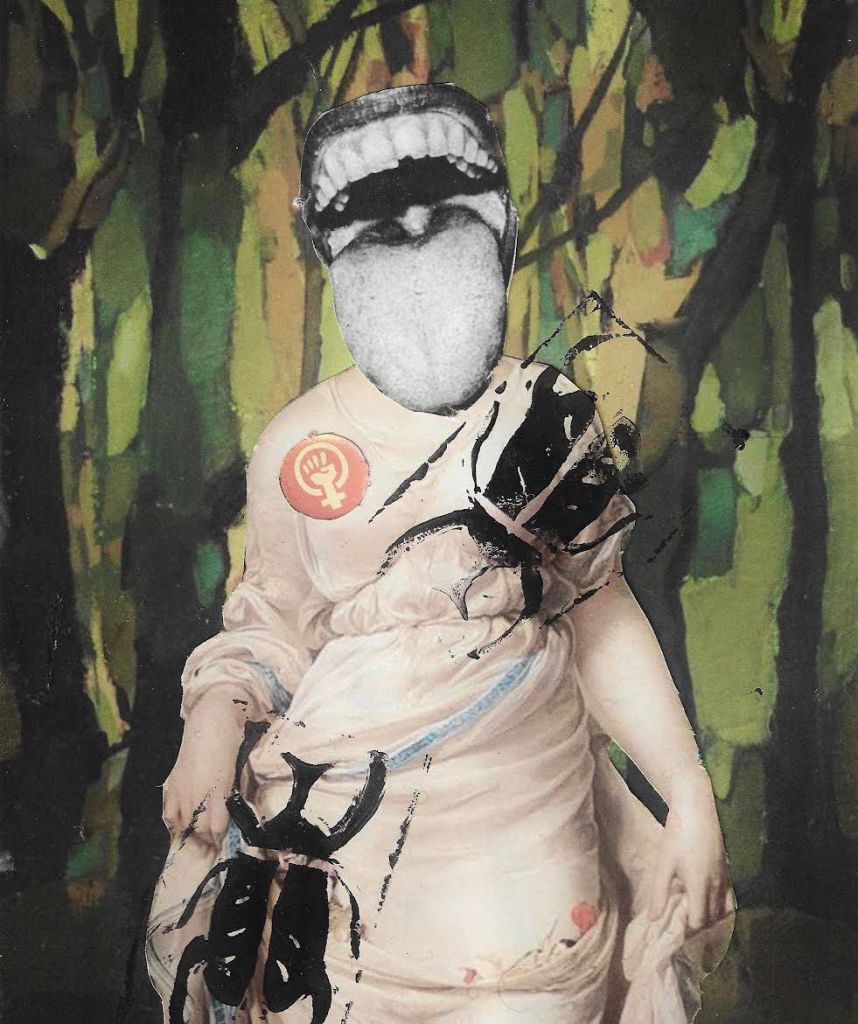
But what happens when a banshee’s liminal space is intruded upon? While this notion is uncommon in older tales of the figure, many later ‘interference legends’ explore the consequences of provoking a banshee through insult, theft, or unwanted advance. One such tale called ‘The Imprint of the Banshee’s Five Fingers’ explores the disastrous consequences of crossing the banshee border. In this legend, a young man is said to have witnessed the banshee’s manifestation at the threshold of his home – emboldened by a night of drinking, and thinking the creature to be a local girl, he made the mistake of clasping a hand upon the banshee’s shoulder, inciting a brutal attack. Though the man was discovered alive the following morning, a print of the banshee’s hand was forever burnt into his skull. Though one may ostensibly view the man of this tale as an unwitting victim or his actions as a harmless exercise in masculine bravado, his intentions are murky. If we are to interpret this unwanted touch as lust-driven, it is clear to see that the banshee’s response is one of defence: an outright refusal to entertain the whims of men. If he should lay hands on her so will she, in a permanent physicalising of his unwanted touch, and women suffering under oppressive patriarchal structures can find empowerment in identification with the banshee. Feminist reclamation of the banshee sees encounters such as these transformed from fireside horror to deeply encoded cautionary tales concerning the violation of a woman’s space.
Today we may feel worlds apart from the challenges faced by women of an incredibly limiting past, but unfortunately many might agree that not much has changed. The streets of Bristol are indeed a far cry from the pastures and tracks of Middle Ages Ireland but the harassment and oppression of the past has found new life in a contemporary locale. In a society where walking down a dimly lit street is a courageous undertaking for the modern woman, I urge readers to consider the strength of the banshee and the generations of women for which this ancient creature served as a fierce radical against male intimidation. I am sure the banshee’s plight is recognisable to many and I am certain her fierce spirit is something we all possess.
 That's What She Said Magazine